Customer acquisition is the mechanism that transforms a business from an idea into an operational entity.
Every company that survives past its early stages does so because it figures out how to consistently attract new customers at a cost that makes economic sense.
But companies that stall eventually run into the same wall: acquisition becomes too expensive, too slow, or too unreliable.
Customer acquisition is the full process of moving someone from awareness to action. It includes the channels you use, the messages you lead with, the objections you remove, and the cost you incur at each step.
This guide breaks customer acquisition down from first principles. It explains what customer acquisition actually is, how it differs from marketing and retention, how the acquisition funnel works in practice, and why many companies are shifting toward flywheel-based growth models.
You’ll see how customer acquisition cost is calculated, what expenses belong in the formula, and how to interpret CAC alongside lifetime value, churn, and revenue timelines.
What Is Customer Acquisition?
Customer acquisition is the complete revenue-generating engine that converts awareness into payment.
It’s the systematic process of attracting prospects, nurturing their interest, and converting them into paying customers.
Every business—from launching bakeries to scaling SaaS companies—needs a repeatable acquisition process to survive.
Definition and Purpose
Customer acquisition encompasses every strategy used to win new customers—from the Instagram ad that catches attention to the email sequence that closes the sale.
It identifies your target audience, understands their pain points, and delivers solutions through channels they use.
Acquisition creates predictable revenue, not just contact lists—but only when costs remain sustainable. Companies measure this as Customer Acquisition Cost (CAC): total spending per customer.
In some sectors, studies show customer acquisition-related costs have climbed roughly 222% since 2013, which means tracking CAC is essential to determine whether your acquisition engine can scale profitably rather than burning capital.
Customer Acquisition vs. Marketing vs. Lead Generation
Customer acquisition is the umbrella term covering the entire journey from stranger to paying customer. Within this system:
- Marketing creates awareness and shapes brand perception through social posts, blog content, and brand campaigns.
- Lead generation converts that awareness into captured contact information—downloads, webinar signups, and quote requests. This moves prospects from awareness to interest.
- Customer acquisition combines both tracking actual purchases—not just email signups. It’s the complete revenue-focused process that marketing and lead generation support.
Customer Acquisition vs Customer Retention
Acquisition targets new customers. Retention keeps existing ones. The economics differ dramatically.
Differences and Objectives
Customer acquisition targets people who’ve never purchased from you. The objective is expansion—growing your customer base and entering new markets. Every acquisition effort starts from zero with prospects who don’t know your brand.
Customer retention focuses on existing customers, shifting objectives from conversion to loyalty. With existing customers, the trust barrier is already cleared.
Acquisition costs 5 to 25 times more than retention. New customers require extensive education and persuasion. Most businesses lose $29 per new customer initially.
Companies accept these losses knowing retained customers generate profits over time. A 5% retention increase boosts profits by 25-95%. Businesses maximizing LTV integrate both into flywheel models where happy customers reduce acquisition costs through referrals.
| Metric | Acquisition | Retention |
| Focus | Converting prospects | Keeping customers |
| Cost | 5-25x higher | Baseline |
| Initial Profit | -$29 average | Positive |
| Trust | Must build | Established |
Why Customer Acquisition Matters
Without new customers, businesses stagnate. Survival depends on consistent acquisition because it fuels two critical outcomes: revenue growth and competitive position.
Business Growth and Revenue
New customers inject revenue that funds expansion and product development. When you develop business ideas that solve real problems, acquisition proves market resonance.
Every industry experiences churn. Acquisition creates buffers against attrition. Profitability requires balancing acquisition costs against customer lifetime value.
Each customer represents recurring revenue, referrals, and data, improving your acquisition engine.
Competitive Advantage and Market Traction
Investors evaluate scalability through three metrics: CAC, payback period, and LTV: CAC ratio. Strong acquisition signals product-market fit.
Market traction appears when acquisition costs stabilize, and conversions become repeatable. Efficient acquisition creates strategic advantages: pricing power from proven demand, partnerships from demonstrated scale, and disproportionate market share through sustainable unit economics.
Customer Acquisition Funnel and Flywheel
Two frameworks compete for how businesses track acquisition. The older model reveals bottlenecks. The newer one compounds returns.
Traditional Acquisition Funnel
The funnel visualizes acquisition as a linear journey. At the top, maximum awareness—lots of prospects. The pool narrows through the consideration and decision stages until a few convert.
- Awareness represents the widest part. Prospects discover your brand through ads, content, social media, or referrals.
- Consideration happens when prospects research options, compare features, and evaluate alternatives.
- Conversion sits at the bottom. Prospects purchase through optimized experiences, reducing friction.
Funnels quantify exactly where prospects drop: 10,000 visitors, but only 50 demos signal a consideration-stage problem.
Funnels treat customers as endpoints, neglecting the post-purchase experience that drives retention and referrals.
Customer Acquisition Flywheel
The flywheel reimagines acquisition as circular and self-reinforcing. Satisfied customers generate momentum, attracting new customers through referrals. Three core stages—Attract, Engage, Delight—create this momentum:
- Attract uses content and inbound marketing, pulling prospects toward valuable resources.
- Engage delivers solutions through demos, consultations, and targeted content, building trust.
- Delight exceeds expectations post-purchase, transforming customers into advocates.
Flywheels generate compounding returns: happy customers reduce CAC 30-40% through referrals.
Businesses using flywheels report 50% higher retention because the organization aligns around customer satisfaction.
Funnels suit transactional, low-LTV sales. Flywheels suit subscriptions and recurring revenue models.
Top, Mid, Bottom Funnel Activities
Top Funnel (Awareness)
- Blog posts, social content, podcasts
- PR introducing your brand to cold audiences
Mid Funnel (Consideration)
- Email sequences, case studies, webinars
- Lead scoring identifies sales-ready prospects
Bottom Funnel (Conversion)
- Free trials, demos, consultative calls
- Optimized checkout, reducing friction
Customer Acquisition Cost (CAC) Explained
CAC is the single most important metric for evaluating acquisition efficiency. Get this wrong, and you’ll burn through capital while thinking you’re growing.
Definition and Importance
Customer Acquisition Cost measures the total expense required to convert one prospect into a paying customer. This includes every dollar spent on marketing, sales salaries, software subscriptions, advertising, and overhead allocated to acquisition activities.
Spending $500 to acquire customers worth $300 creates unsustainable economics. Conversely, spending $100 to acquire customers worth $500 creates a profitable growth engine.
CEOs and investors scrutinize CAC because it reveals operational efficiency. Rising CAC signals market saturation, weakening competitive position, or ineffective marketing. Declining CAC suggests improving brand recognition, better targeting, or more effective sales processes.
CAC Formula and Example
The standard CAC formula divides total acquisition costs by new customers acquired:
CAC = (Marketing Spend + Sales Wages + Software + Outsourced Services + Overhead) / New Customers Acquired
Example: First quarter bakery acquisition costs:
Marketing ($4,000) + Sales wages ($3,000) + Software ($500) + Outsourced services ($1,500) + Overhead ($1,000) = $10,000 total costs. With 80 new customers acquired: CAC = $10,000 / 80 = $125 per customer.
This $125 CAC only matters in context: if average customers spend $400 lifetime, your 3.2:1 LTV:CAC ratio signals healthy economics. Strip that context and the number means nothing.
How CAC Can Mislead
CAC isn’t foolproof. Three scenarios distort the metric:
Long-term campaigns inflate short-term CAC. A six-month SEO initiative costing $15,000 generating 10 month-one customers shows $1,500 CAC. By month six with 200 customers, CAC drops to $75. Solution: Calculate CAC over full campaign duration, not arbitrary monthly windows.
Purchase frequency differences create false comparisons. Subscription businesses spending $50 monthly versus annual contracts at $600 once require contextual interpretation.
Attribution complexity muddies calculations. Multi-touch journeys across channels need proper attribution, not just last-click credit.
Context matters. Compare CAC to customer lifetime value, industry benchmarks, and your business model.
Customer Acquisition Channels
Organic channels build equity over time. Paid channels buy immediacy—and require continuous fuel.
Organic Channels
Organic channels generate traffic without direct advertising spend. They require upfront investment in content and optimization but deliver compounding returns over time.
Organic Search / SEO
SEO attracts prospects actively searching for solutions. Unlike ads, SEO captures intent-driven traffic—people already interested.
SEO operates on three layers. On-page optimization targets keywords through titles, headers, and content. Technical SEO ensures crawlability—fast loads, mobile responsiveness, clean URLs. Backlinks then signal authority when reputable sites reference your content. Each layer builds on the previous one.
Start with keyword research (SEMrush, Ahrefs, Moz). Identify terms your audience searches, assess competitive difficulty, then prioritize based on volume-to-difficulty ratio. Focus on search intent—what people want when searching.
SEO’s advantage is low ongoing cost with $647 average CAC. The tradeoff? Expect 6-12 months for substantial results.
Organic Social Media
Social platforms build brand awareness and community without paid promotion. Regular posting, engagement with followers, and content that encourages sharing create viral potential that amplifies reach beyond your direct audience.
Consistency and value drive success. Posting sporadically or purely promotional content kills engagement. Platforms reward accounts that generate conversation, shares, and meaningful interaction. Educational content, behind-the-scenes glimpses, and user-generated content typically outperform sales pitches.
Organic social works best for businesses with visually compelling products, strong brand personalities, or communities passionate about their niche. Building substantial followings takes months or years of sustained effort.
Content Marketing & Blogging
Content marketing attracts prospects by solving problems before asking for anything. Blog posts, guides, and videos demonstrate expertise while building trust.
Address specific pain points your audience faces. When you evaluate your business idea thoroughly, you uncover problems to address through content.
Sustainable cadence beats frequency—one monthly post you can maintain outperforms a sprint that burns out. Promotion carries equal weight to creation: distribute across channels, leverage your email list, and pursue cross-promotional partnerships.
Paid Channels
Paid channels buy immediate visibility. They deliver faster results than organic methods but require continuous investment to maintain traffic.
Paid Search / PPC
Pay-per-click on Google Ads and Microsoft Ads targets prospects actively searching. Bid on keywords, write ads, and pay per click.
PPC excels at high-intent traffic. Someone searching “hire commercial cleaning chicago” is ready to buy. The challenge is rising costs—average paid search CAC is $1,200.
Quality Score determines placement and cost. Google rewards advertisers who align ads and landing pages with user intent. Higher scores mean lower costs and better positions.
Paid Social Media
Facebook, Instagram, LinkedIn, and TikTok ads target demographics, interests, and behaviors. Average social CAC is $1,100.
Targeting precision reduces wasted spend on irrelevant audiences. You can reach specific demographics with granular detail.
Creative fatigue is the enemy. Refresh ad creative every 2-3 weeks to maintain performance.
Sponsored Content / Influencers
Partner with creators for access to established audiences. Authentic partnerships reduce CAC by 30-40% versus traditional advertising.
Micro-influencers (10,000-100,000 followers) often deliver better ROI with more engaged, targeted audiences at lower costs.
Referral and Event Channels
Referral programs achieve the lowest CAC of any channel because referred customers arrive pre-qualified and pre-sold. Dropbox proved this at scale: “refer a friend, both get extra storage” drove explosive growth with near-zero acquisition cost by letting existing customers do the selling.
Events and webinars work well for B2B businesses and high-consideration purchases. They create opportunities for extended engagement that’s impossible through ads or content alone. Virtual events scale better than in-person but generate less commitment. People will ghost a webinar they registered for but rarely skip an event they traveled to attend.
Customer Acquisition Strategies
Channels represent where you acquire customers. Strategies orchestrate those channels into coherent acquisition engines.
Strategy Mix Overview
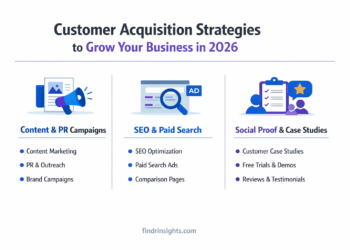
No single channel dominates customer acquisition. The businesses acquiring customers most efficiently combine multiple channels, test continuously, and allocate resources based on performance data rather than assumptions.
Map channels to your customer journey. Top-of-funnel awareness might come from SEO and social media. Middle-funnel consideration could involve email nurturing and retargeting ads. Bottom-funnel conversion might happen through sales calls or optimized checkout experiences. Each stage requires different tactics.
Experimentation beats perfection. Launch small tests across multiple channels, measure results objectively, and double down on what works. Many businesses waste resources perfecting strategies in underperforming channels when they should be testing new ones.
SEO & Content Strategies
Search-driven acquisition works well for businesses solving specific problems prospects research. Create comprehensive content targeting keywords customers use.
Long-form guides establish authority and capture featured snippets. A 3,000-word post outranks ten 300-word fragments.
Gated content generates leads by exchanging resources for contact information. Templates and tools work well when value justifies the exchange.
Internal linking strengthens SEO while guiding prospects. Linking to your comprehensive business plan helps readers take logical next steps.
CTAs embedded contextually convert readers. Position offers where they make sense rather than interrupting flow.
Social Media & Video
Social combines organic community-building with paid promotion. Engagement matters more than follower count. An account with 1,000 engaged followers converts better than 10,000 passive ones.
Video content dominates attention. Short-form on TikTok, Reels, and YouTube Shorts reaches audiences through algorithmic distribution.
Visual storytelling makes concepts concrete. Show pricing strategies through infographics rather than text.
Email and Retargeting
Email acquisition builds subscriber lists and nurtures prospects through automated sequences. Average email CAC of $510 makes it highly cost-effective.
Behavior-based segmentation sends messages matching user actions—pricing downloaders get different sequences than product browsers. A/B testing then optimizes execution: subject lines, send times, and CTAs.
Retargeting re-engages site visitors who didn’t convert, costing less and converting better than cold targeting.
Product and Pricing Strategies
Your product drives acquisition. Freemium lets prospects experience value before paying. Dropbox’s free tier introduced millions to cloud storage, converting users exceeding limits.
Otter.ai offers free monthly transcription credits. Users develop dependency, then upgrade when needing more capacity.
Promotional pricing lowers trial barriers through limited-time discounts and guarantees. Avoid conditioning customers to wait for discounts.
Customer Spotlights and Testimonials
Social proof reduces skepticism more than sales pitches. Prospects trust customers more than you. Case studies and testimonials demonstrate real results.
Video testimonials convert better than written. Seeing satisfied customers creates emotional connection.
User-generated content creates viral loops. Encourage sharing through contests and branded hashtags, amplifying reach without additional spending.
How to Measure Customer Acquisition
Measurement separates guesswork from strategy. Without tracking the right metrics, you’re optimizing blindly. With CAC’s limitations understood, focus shifts to the metrics that contextualize these costs—and how to optimize them.
CAC and Supporting Metrics
| Metric | Formula | Healthy Benchmark |
| CAC | Total Acquisition Costs / New Customers | Varies by industry ($50-$3,500) |
| LTV | Avg Purchase Value × Frequency × Lifespan | 3-5x CAC |
| LTV:CAC Ratio | LTV / CAC | Minimum 3:1 |
| Payback Period | CAC / Monthly Profit per Customer | 6-12 months |
| Churn Rate | Lost Customers / Total Customers | Under 5% monthly |
Customer Lifetime Value (LTV) measures total revenue one customer generates over their entire relationship with your business. A customer spending $50 monthly for 24 months has a $1,200 LTV.
LTV:CAC Ratio determines acquisition sustainability. The minimum viable ratio is 3:1—each customer should generate three times what you spent acquiring them. Ratios below 2:1 indicate problems. Above 5:1 suggests you’re underinvesting in acquisition and missing growth opportunities.
Payback Period measures how long it takes to recover acquisition costs. If you spend $300 to acquire a customer generating $100 monthly profit, your payback period is three months.
Conversion Rate tracks what percentage of prospects become customers at each funnel stage. Low conversion rates signal targeting problems, weak value propositions, or friction in the purchase process.
Churn Rate measures customer attrition. Calculate monthly churn by dividing customers lost by total customers at period start. High churn destroys LTV calculations and makes CAC unsustainable.
ROI and Campaign Attribution
Multi-channel attribution tracks which touchpoints deserve credit for conversions. Simple last-touch attribution credits the final interaction before purchase. This systematically undercounts awareness and consideration activities that initiated the relationship and built trust over time.
First-touch attribution credits the initial interaction. This overcredits top-of-funnel activities while ignoring nurturing and conversion efforts that actually closed the sale.
Multi-touch attribution distributes credit across all touchpoints customers experience. Linear models split credit equally among all interactions. Time-decay models give more credit to recent interactions based on recency. Position-based models emphasize first and last touches while acknowledging middle interactions that maintained engagement throughout the journey.
Campaign-level CAC calculates acquisition costs per initiative rather than averaging across all activities. This reveals which specific campaigns acquire customers efficiently versus which waste resources on low-converting audiences. Calculate by dividing campaign costs by customers acquired through that campaign specifically, not total customers from all sources during that period.
Gaps and Pitfalls in Measurement
Several common mistakes distort CAC calculations and lead to poor decisions:
Excluding overhead creates artificially low CAC. Your acquisition efforts use office space, utilities, technology infrastructure, and management time. Allocate reasonable portions of these costs to get accurate CAC that reflects true investment.
Ignoring delayed conversions penalizes long-cycle channels. SEO, content marketing, and brand-building initiatives generate returns over months or years. Evaluating them on 30-day windows undercounts their true contribution and leads to cutting successful long-term strategies.
Attribution errors misallocate credit. Automated attribution models work well for digital touchpoints but miss offline interactions completely. A prospect might discover you through a podcast ad, research via Google, and convert after a sales call. Simple attribution might credit the sales call while ignoring the podcast that initiated awareness and drove interest.
Not segmenting by cohort hides trends and obscures performance patterns. Calculate CAC separately for different customer segments, time periods, and channels to identify what’s working. Overall average CAC might look healthy while specific segments or channels perform terribly, wasting significant portions of your marketing budget on ineffective targeting.
How to Improve Your Customer Acquisition Strategy
Optimization never stops. Markets shift, competition intensifies, and what worked last quarter might fail next month.
Sustainability and Flexibility
Long-term content production builds compounding advantages. A blog post published today might generate traffic for years. Video content gets discovered through search and recommendations long after creation. This creates acquisition momentum that doesn’t require continuous investment.
Flexibility means adapting when channels stop working. Facebook ads that converted at $50 CAC in 2020 might cost $200 in 2025. Rather than throwing more money at declining channels, test alternatives before performance completely collapses.
Build optionality by testing multiple channels simultaneously. Over-dependence on any single source creates vulnerability. When Facebook changed its algorithm, businesses relying exclusively on organic reach saw traffic disappear overnight.
Target Market Identification
Precise targeting reduces wasted acquisition spend. Generic messaging to broad audiences costs more and converts worse than specific messaging to narrow segments.
Develop detailed customer personas based on actual data, not assumptions. Interview existing customers about their decision process. What problem were they trying to solve? What alternatives did they consider? What convinced them to choose you? These insights reveal which prospects to target and how to position your offering.
Audience research uncovers where your customers spend time, which influencers they trust, what content they consume, and how they prefer to buy. This directs channel selection and messaging strategy.
Diversification and Channel Optimization
Test multiple acquisition channels to identify what works for your specific business. What succeeds for competitors might fail for you based on your positioning, pricing, product, or target audience.
Start small with channel tests. Invest $500-$1,000 in a new channel to gather performance data before committing larger budgets. Track CAC, conversion rates, and customer quality—not all customers are equally valuable.
Resource allocation should follow performance. Double down on channels delivering strong CAC and LTV while cutting or testing alternatives for underperformers. This sounds obvious but many businesses continue spending on channels they launched years ago without questioning whether they still work.
Focus on Retention and LTV
Improving retention reduces effective CAC even when acquisition costs stay constant. If you currently spend $200 acquiring customers who stick around 12 months, and you improve retention so they stay 18 months instead, you’ve effectively reduced CAC by 33% without changing acquisition tactics.
Reducing churn transforms economics dramatically. A 5% improvement in retention can boost profits by 25-95% because retained customers generate revenue without requiring new acquisition investment.
Convert customers into repeat buyers through excellent service, regular engagement, and ongoing value delivery. When you’re investing in quality equipment or improving product quality, you’re improving retention—which improves acquisition economics.
Integrate retention into your acquisition flywheel. Happy customers refer others, reducing acquisition costs through word-of-mouth. They provide testimonials that increase conversion rates. They offer product feedback that improves offerings for future customers. Viewing acquisition and retention as separate functions misses these compounding effects.
Customer Acquisition Strategy Examples
Real-world examples demonstrate how businesses apply acquisition principles across different models.
Freemium Model Example
Dropbox pioneered viral freemium acquisition. Users got free cloud storage with incentives to earn more by referring friends. Each referral gave both parties additional storage, creating mutual motivation to share. This reduced Dropbox’s CAC to nearly zero—customers essentially acquired themselves through referrals.
Otter.ai uses similar mechanics. Free transcription credits introduce users to the product. As they use it for meetings and notes, dependency develops. When free credits run out, conversion to paid plans happens naturally based on demonstrated value rather than aggressive sales.
Free users must experience genuine value while upgrade paths remain clear. The common mistake—crippling free versions to force conversions—backfires. Frustrated users abandon rather than upgrade.
Email Acquisition Example
Kaleigh Moore built a substantial consulting business through her newsletter focused on eCommerce and retail. By publishing valuable, actionable content weekly, she established authority and trust. Subscribers became clients without traditional sales processes because they already knew her expertise from consistent email contact.
This demonstrates email’s power for high-consideration services. When prospects need months to make buying decisions, email nurtures relationships without being intrusive. The CAC for newsletter-driven acquisition is typically under $100—far lower than sales-driven approaches.
Gated Content Example
HubSpot mastered gated content acquisition. Their website offers hundreds of free templates, tools, and resources in exchange for contact information. The “Make My Persona” tool helps marketers build customer profiles while capturing leads for HubSpot’s CRM and marketing automation products.
The value exchange is clear—marketers get immediately useful resources, HubSpot gets qualified leads interested in marketing technology. This approach works because the gated content solves specific problems prospects face, demonstrating product expertise in the process.
Organic Search Example
Chima Mmeje built her SaaS SEO consultancy entirely through organic search. By ranking for keywords like “SaaS content marketing” and “B2B SEO strategy,” she attracts clients already searching for her specific expertise. The content demonstrates capability better than any sales pitch could.
SEO-driven acquisition works exceptionally well for businesses solving searchable problems. The CAC is minimal after initial content investment, and the leads arrive highly qualified because they’re actively seeking solutions.
Common Customer Acquisition Mistakes to Avoid
Even experienced businesses make predictable acquisition errors that destroy efficiency.
Over-reliance on Single Channel
Businesses that built entire acquisition engines on Facebook ads learned painful lessons when iOS 14 privacy changes decimated targeting effectiveness. CAC doubled or tripled overnight. Companies with diversified channel mixes absorbed the change by reallocating to alternatives.
Platform dependency creates existential risk. Algorithm changes, policy updates, or competitive saturation can eliminate channels that worked for years. Maintain active acquisition in at least 3-5 channels to protect against single-channel collapse.
Ignoring Attribution Accuracy
Simple attribution models systematically misallocate resources. Crediting only the last touchpoint before purchase undervalues awareness and consideration activities that initiated customer relationships.
A prospect might discover you through a podcast ad, research via organic search, sign up for your email list, and convert from a retargeting ad months later. Last-touch attribution credits the retargeting ad while ignoring the podcast that started everything. This leads to underinvesting in awareness channels and over-investing in retargeting.
Implement multi-touch attribution to understand the complete customer journey. This requires tracking tools that connect touchpoints across channels and devices—complex but essential for accurate optimization.
Scaling Too Early / Neglecting Churn
Pouring money into acquisition before solving retention creates a leaky bucket. You’re filling a container that drains as fast as you fill it. The math doesn’t work.
Fix retention before scaling acquisition. If customers churn after three months, acquiring more customers faster just accelerates the churn rate. Focus first on extending customer lifespan, then invest in acquisition once economics become sustainable.
High churn signals product-market fit problems, poor onboarding, or mismatched customer expectations. These issues rarely fix themselves with volume. More customers just means more unhappy customers leaving faster.
Future Trends in Customer Acquisition
Acquisition strategies evolve rapidly as technology, privacy regulations, and consumer behavior shift.
AI and Automation in Lead Generation
Artificial intelligence transforms acquisition efficiency. AI-powered tools analyze buyer behavior, predict conversion likelihood, and optimize campaigns in real-time. Early adopters see CAC reductions up to 50% through better targeting and personalization.
Machine learning identifies high-value prospects by analyzing patterns in existing customer data. Instead of targeting broad demographics, AI predicts which specific individuals resemble your best customers and prioritizes them accordingly.
Chatbots and conversational AI qualify leads, answer questions, and schedule sales calls without human intervention. This scales customer interaction without proportionally scaling costs. The $47 billion AI marketing technology market is growing 36.6% annually—reflecting proven ROI rather than speculative hype about potential applications.
Dynamic creative optimization uses AI to test thousands of ad variations, automatically serving the best-performing version to each audience segment. What once required weeks of manual A/B testing now happens automatically at scale without extensive manual intervention.
Privacy, Cookie Deprecation, Attribution Changes
Third-party cookie deprecation eliminates tracking mechanisms that powered targeted advertising for decades. Businesses relying on pixel-based retargeting and cross-site tracking face rising CAC as precision decreases dramatically.
Privacy regulations like GDPR and CCPA limit data collection and usage. This forces businesses toward first-party data strategies—collecting information directly from customers rather than buying it from third parties or tracking across websites.
Privacy-first acquisition emphasizes permission-based relationships. Email lists, loyalty programs, and community-building create direct customer connections that don’t depend on third-party tracking infrastructure that’s rapidly disappearing.
Attribution becomes more challenging as cross-site and cross-device tracking disappears. Businesses need probabilistic attribution models and incrementality testing to understand channel effectiveness without perfect tracking across every customer touchpoint.
Community-Led Growth and Advocacy
Community-driven acquisition leverages customer networks rather than paid advertising. When customers feel belonging to a community around your product, they recruit others organically through genuine enthusiasm.
Brands building strong communities see acquisition costs drop 30-40% as word-of-mouth and peer recommendations replace advertising spend. Peloton, Notion, and Salesforce all use community as acquisition engines that fuel sustainable growth.
User-generated content amplifies reach without additional marketing investment. Customers creating content about your product reach their networks authentically—far more persuasive than branded messaging that triggers skepticism.
Creator partnerships continue growing as traditional advertising effectiveness declines. Influencer collaborations deliver 30-40% lower cost per lead than standard advertising when authentic alignment exists between creator and brand values.
Key Takeaways
Customer acquisition isn’t about choosing between channels or tactics—it’s about building a systematic, measurable process that attracts the right customers at sustainable costs.
CAC is your north star metric. Calculate it accurately by including all acquisition-related costs. Track it religiously and compare against customer lifetime value to ensure sustainable economics. The minimum viable LTV:CAC ratio is 3:1, with healthy businesses achieving 4:1 or better.
No single channel dominates. The businesses acquiring customers most efficiently test multiple channels, measure performance objectively, and allocate resources based on data rather than assumptions. Start with small experiments before committing large budgets.
Retention amplifies acquisition. Every improvement in customer retention effectively reduces CAC even when acquisition costs stay constant. Focus on extending customer lifespan and reducing churn before scaling acquisition spending.
Flywheel beats funnel for sustainable growth. Treating customers as the endpoint misses the compounding effects of advocacy, referrals, and repeat purchases. Build acquisition strategies that convert satisfied customers into acquisition engines through word-of-mouth.
| Element | Funnel Approach | Flywheel Approach |
| Focus | Linear conversion | Circular momentum |
| Customer Role | Endpoint | Ongoing driver |
| Post-Purchase | Minimal emphasis | Critical for referrals |
| Best For | Transactional sales | Recurring revenue |
| Growth Pattern | Additive | Compounding |
Acquisition costs have tripled since 2013 and average businesses lose $29 on initial customer acquisition. This makes efficient targeting, strong retention, and sustainable economics more critical than ever. The businesses thriving in 2025 aren’t those spending the most on acquisition—they’re those acquiring the right customers, keeping them satisfied, and turning them into advocates who reduce future acquisition costs.
Whether you’re starting a home-based business or scaling an established company, customer acquisition deserves rigorous measurement and continuous optimization. Calculate your CAC honestly, compare it against industry benchmarks, and test systematically to find what works for your specific market, product, and positioning.
Frequently Asked Questions
What is the difference between customer acquisition cost and customer lifetime value?
Customer acquisition cost measures how much you spend to win one customer. Customer lifetime value calculates total revenue that customer generates over their entire relationship with your business. The ratio between these two metrics determines whether your business model is sustainable. You need customers to generate at least three times what you spent acquiring them to build a profitable business. CAC answers “what did this customer cost me?” while LTV answers “what is this customer worth?”
How can small businesses reduce customer acquisition costs?
Small businesses reduce CAC by focusing on organic channels that require time rather than large budgets. SEO and content marketing generate compounding returns as published content continues attracting traffic months or years later without ongoing spending.
Referral programs turn existing customers into acquisition engines at minimal cost. Email marketing costs pennies per message while converting at higher rates than cold outreach.
Community building through social media creates word-of-mouth that scales beyond paid advertising. The key is accepting that organic channels take longer to produce results but deliver far better economics once established.
What’s a good customer acquisition cost for my industry?
Good CAC varies dramatically by industry based on customer lifetime value and purchase frequency. eCommerce businesses average $50-$274 CAC because individual purchases are relatively small.
SaaS companies average $250-$3,500 because annual contracts justify higher acquisition spending. B2B services often spend $1,000+ acquiring customers who generate tens of thousands in lifetime revenue.
The universal benchmark is LTV:CAC ratio—your customers should generate at least three times what you spent acquiring them. If your industry has high lifetime values, higher acquisition costs are justified.
How do you calculate customer acquisition cost for a startup?
Startups calculate CAC by dividing total sales and marketing expenses by new customers acquired during that period.
Include marketing spend, sales salaries, software subscriptions, advertising costs, event expenses, and allocated overhead. Track this monthly initially to identify trends quickly.
Many startups make the mistake of excluding costs like founder time spent on sales or overhead allocated to acquisition activities, which artificially deflates CAC and leads to poor decisions.
Be comprehensive in cost calculation and honest about time investments to get accurate numbers that inform resource allocation.
Should I focus more on customer acquisition or customer retention?
Both matter but retention delivers higher ROI once you have initial customer base.
Acquisition costs 5-25 times more than retention, and a 5% improvement in retention can boost profits by 25-95%. New businesses need acquisition to build customer base—you can’t retain customers you don’t have.
Established businesses often overinvest in acquisition while neglecting retention, creating a leaky bucket problem where customers churn as fast as new ones arrive.
The optimal approach balances both—acquire enough new customers to offset natural churn and fuel growth, while investing heavily in retention to maximize lifetime value and generate word-of-mouth that reduces future acquisition costs.
For more guidance on building sustainable business strategies, explore business idea resources that help you plan for both acquisition and retention from the start.