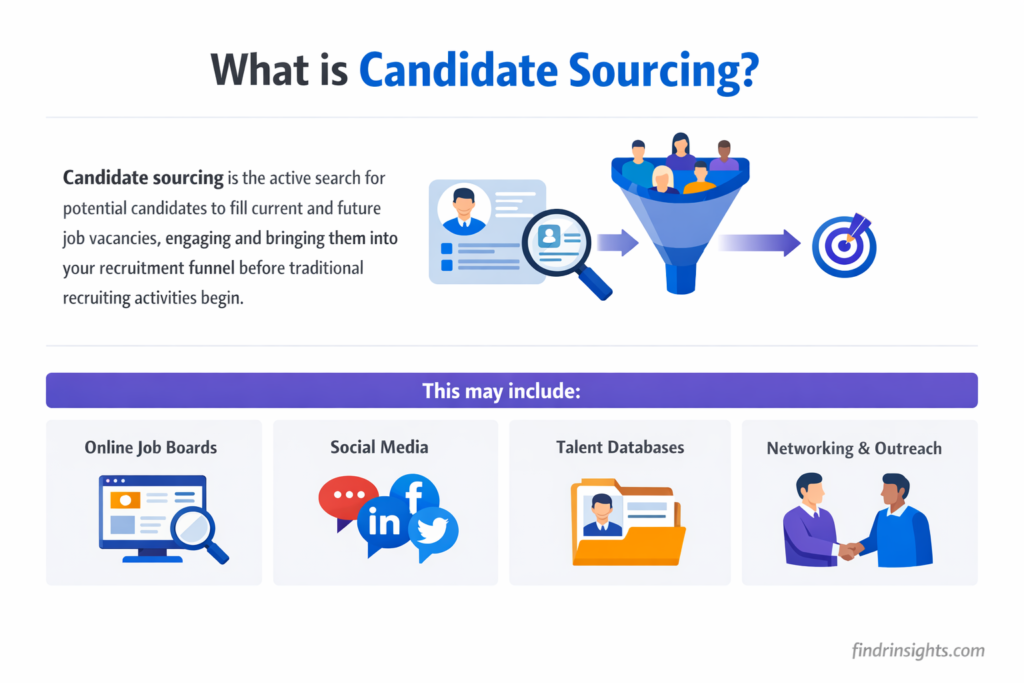
Candidate sourcing identifies and engages qualified candidates before they apply to your jobs.
This proactive approach enables you to build relationships with top talent, fill specialized roles faster, and compete effectively in tight labor markets by reaching people who might never see your job postings.
Throughout this guide, you’ll explore the foundational definition of sourcing, practical methods for finding both active and passive candidates, AI tools that reduce sourcing time by 75%, and the key metrics that demonstrate whether your sourcing efforts are delivering results.
Key Takeaways:
- Sourcing identifies and attracts talent before formal applications
- Effective sourcing cuts time-to-hire by 52% and boosts offer acceptance by 67%
- Modern sourcing combines traditional methods with AI automation and Boolean search
- Success depends on measuring quality of hire, source effectiveness, and conversion rates at each pipeline stage
Candidate Sourcing: Meaning and Definition in Recruitment
Candidate Sourcing Definition
Candidate sourcing is the active search for potential candidates to fill current and future job vacancies through various channels, bringing them into your recruitment funnel before traditional recruiting activities begin.
In recruitment and HR operations, sourcing represents the front-end discovery work that happens before screening and interviewing. Job postings attract candidates who come to you, but sourcing takes the opposite approach by going directly to candidates, including those who aren’t actively looking for new opportunities.
What Candidate Sourcing Means in Practice
Sourcing functions as the discovery phase of talent acquisition, building pipelines of qualified candidates who match specific role requirements through research across professional networks, databases, and specialized platforms.
The relationship between sourcing and hiring outcomes is direct. ClearCompany reports that their AI sourcing engine fills critical roles 52% faster and boosts offer acceptance rates by 67%, alongside reducing first-year turnover by 42% and achieving 91% candidate satisfaction.
Instead of waiting for the perfect applicant to find your posting, sourcing allows you to create opportunities with people who might not have considered your organization otherwise, giving you access to talent that your competitors miss.
Candidate Sourcing in HR and Recruitment Operations
Within end-to-end recruitment, sourcing occupies the earliest stage, preceding screening, interviewing, and selection. Your sourcing efforts determine the quality and diversity of candidates who eventually move through your hiring funnel.
Understanding how these functions relate to each other clarifies where sourcing fits in your talent acquisition process.
Sourcing fills the pipeline by finding and attracting candidates, recruiting encompasses the complete hiring cycle from sourcing through onboarding, and hiring represents the final decision and offer acceptance.
Each function builds on the previous one, with sourcing establishing the foundation for everything that follows.
Candidate Sourcing vs Screening in Recruitment
What Candidate Sourcing and Screening Represent
Sourcing and screening are sequential but distinct functions. Sourcing identifies potential candidates and generates interest in opportunities, while screening evaluates those candidates against specific job requirements to determine who advances to interviews.
Sourcing always precedes screening because you need a pool of candidates before you can evaluate them.
This sequential relationship creates a natural handoff point where the sourcer’s job is complete and qualified candidates enter your applicant tracking system, marking the beginning of the screener’s responsibilities.
Candidate Sourcing and Screening Workflow
Your sourcing inputs include job requirements, ideal candidate profiles, and target sourcing channels. You conduct research, reach out to passive candidates, and build relationships that generate applications or referrals.
Screening outputs are shortlists of qualified candidates ready for interviews. The quality of your sourcing work directly impacts screening efficiency because effective sourcing delivers qualified candidates and reduces the time screeners spend reviewing applications.
When sourcing quality declines, screeners face floods of unqualified applicants that create bottlenecks throughout the hiring process.
Sourcing vs Screening Comparison:
| Aspect | Candidate Sourcing | Candidate Screening |
| Primary Focus | Finding and attracting candidates | Evaluating candidate qualifications |
| Timeline | Occurs first, often ongoing | Follows sourcing, episodic |
| Key Activities | Research, outreach, relationship building | Resume review, initial assessments |
| Success Metric | Number of qualified candidates in pipeline | Percentage of candidates advancing to interviews |
| Skillset Required | Research, networking, persuasion | Evaluation, judgment, organization |
Understanding these distinct functions helps you recognize the two primary candidate streams that sourcing efforts target.
Types of Candidate Sourcing Streams
Active Candidate Sourcing
Active candidate sourcing targets individuals currently searching for new employment, including people visiting job boards, updating resumes, and actively applying to positions.
Typical channels for active sourcing include job boards like Indeed and LinkedIn, career fairs, and direct applications through your company website.
Because these candidates are motivated to find new roles, they respond quickly to outreach and move through hiring stages with minimal persuasion needed, making active sourcing the most efficient approach when you need to fill entry-level positions, have straightforward role requirements, or anticipate high application volume from qualified candidates who are readily available and actively job searching.
Passive Candidate Sourcing
Passive candidate sourcing identifies and engages people who aren’t actively job hunting but possess the qualifications you need.
While these individuals are typically employed and satisfied in their current roles, 85% remain open to discussing opportunities under the right circumstances, creating a massive pool of potential talent that most employers overlook.
Passive candidates represent 70% of the global workforce. Since the best talent is rarely unemployed or actively searching, passive sourcing becomes essential for accessing top performers who are already succeeding in their current roles.
When you’re filling specialized roles requiring niche skills or senior expertise, passive candidates often represent your only viable talent pool because the small number of people with these qualifications are almost always employed.
Active and Passive Candidate Sourcing Compared
Active candidates offer speed and volume, responding faster to outreach, moving through hiring stages quickly, and requiring less persuasion.
The inherent tradeoff comes from competition, since every other employer can access the same active candidate pool, reducing your ability to find overlooked talent.
Passive candidates deliver quality and reduced competition because they’re already successful in their roles and bring proven performance records that active job seekers may lack.
The investment required includes more time per candidate, personalized outreach that acknowledges their current satisfaction, and patience as candidates weigh potential career changes against their existing situations.
Your sourcing strategy should match these approaches to your hiring context. When facing high-volume hiring or entry-level roles, emphasizing active sourcing maximizes candidate flow and fills positions quickly.
For specialized positions, executive searches, or building competitive advantage, investing in passive sourcing strategies provides access to talent your competitors can’t reach.
Candidate Sourcing Streams Used by Modern Teams
Internal talent pools consist of previous applicants who weren’t hired, former employees who left on good terms, and internal candidates ready for advancement. These people already understand your organization and have demonstrated prior interest.
Referrals from current employees tap into their professional networks. Referred candidates accept offers 15% more often and perform up to 15% better than non-referred hires. Building a small business from the ground up often starts with referral-based hiring before formal sourcing programs exist.
External platforms include LinkedIn, GitHub, Stack Overflow, and industry-specific networks where professionals congregate. Your sourcing strategy should map where your ideal candidates spend time online and offline.
Candidate Sourcing Methods and Techniques
Traditional Candidate Sourcing Methods
Job boards remain the foundation of active candidate sourcing. Posting on Indeed, Monster, and niche industry boards attracts candidates actively searching. While straightforward, job boards generate high application volume, requiring significant screening effort.
Referrals from employees, customers, and professional contacts provide pre-vetted candidates. Since someone vouches for their abilities and fit, referrals convert at higher rates throughout the hiring process.
Recruitment agencies handle sourcing and initial screening for organizations lacking internal capacity. Agencies provide access to their existing candidate networks and specialized sourcing expertise, though at higher cost per hire.
Advanced Candidate Sourcing Techniques
Boolean search uses logical operators like AND, OR, and NOT to create precise search queries across databases and search engines. Instead of searching “software engineer,” you might search “(software OR application) AND (engineer OR developer) AND Python NOT intern” to target exactly who you need.
These Boolean operators work universally across Google, LinkedIn, applicant tracking systems, and resume databases. The basic operators include AND to require both terms, OR to accept either term, NOT to exclude terms, quotation marks for exact phrases, and parentheses for grouping complex searches into logical structures.
Talent mapping involves systematically identifying all professionals in a specific field, company, or geographic area. You’re creating comprehensive lists of potential candidates before you have open positions, building relationships proactively.
Community-based sourcing engages candidates where they naturally gather. Join professional associations, attend industry conferences, participate in online forums, and contribute to technical communities. You’re building employer brand awareness while identifying engaged professionals.
Passive Candidate Sourcing Techniques
Outreach frameworks for passive candidates require personalized, value-focused messaging structured around three elements: acknowledging their current employment, explaining your specific interest in them, and offering a low-commitment exploratory conversation.
When crafting subject lines, reference shared connections or specific achievements rather than generic “job opportunity” language. Talented candidates receive dozens of recruiter messages weekly, so yours must stand out through relevance and personalization that demonstrates genuine interest in their unique background.
Relationship-based sourcing invests in long-term connections before you need to fill roles. Follow candidates on social media, engage with their content, share relevant articles, and maintain periodic contact. When the right opportunity arises, you’ve already established trust and credibility that makes candidates more receptive to your outreach.
Candidate Sourcing Ideas for Competitive Roles
Hard-to-fill roles demand creative sourcing approaches that expand beyond traditional candidate pools. Target professionals with adjacent skills who could transition into your role, or source from companies facing layoffs or industry contraction where talented people might welcome opportunities.
For niche skill sourcing, go where specialists congregate and demonstrate their expertise. Source Ruby developers from RubyConf and local meetups, find data scientists on Kaggle, and identify designers through Dribbble portfolios. Platform-specific sourcing yields higher-quality matches because you’re targeting demonstrated expertise rather than self-reported skills.
Candidate Sourcing Process and Steps
Candidate Sourcing Process Overview
The sourcing process begins at role intake and concludes when qualified candidates enter your interview pipeline. You’re translating hiring manager requirements into sourcing strategies, executing outreach, and tracking candidate engagement throughout the journey.
This process runs parallel to your ongoing recruitment operations. While you’re interviewing candidates for current roles, you’re simultaneously sourcing for future needs, building continuous talent pipelines rather than scrambling when positions open.
Step-by-Step Candidate Sourcing Workflow
Your first step involves defining role requirements through intake meetings with hiring managers, documenting must-haves, nice-to-haves, experience levels, and culture fit before applying evaluation frameworks to separate essential from preferred qualifications.
Second, select sourcing channels based on where your ideal candidates are active. For software engineers, prioritize GitHub and Stack Overflow over general job boards. For marketing professionals, focus on LinkedIn and industry conferences where they’re most likely to engage.
Third, identify candidates using Boolean searches, database queries, and platform-specific tools while building lists of potential candidates with documented contact information and preliminary qualification notes.
Fourth, engage prospects through personalized outreach that acknowledges their current situation and offers clear value propositions. Track responses, follow up consistently, and nurture relationships even when candidates aren’t immediately ready to move, maintaining these connections for future opportunities.
Candidate Sourcing Steps Mapped to Hiring Stages
Early-stage sourcing happens before roles are even posted, building relationships with potential candidates, creating awareness of your employer brand, and developing talent pools for anticipated future needs. This proactive approach means qualified candidates are ready when positions open, dramatically reducing your time-to-fill.
Ongoing pipeline building maintains consistent sourcing activities regardless of immediate hiring needs. This continuous approach involves adding new candidates to your database, re-engaging past candidates who weren’t ready previously, and strengthening relationships with passive talent so you’re never starting from scratch.
Candidate Sourcing Process Table:
| Stage | Key Activities | Timeline | Output |
| Planning | Define requirements, identify channels | 1-2 days | Sourcing strategy document |
| Research | Search databases, identify candidates | Ongoing | Candidate lists with contact info |
| Outreach | Send personalized messages, follow up | 1-2 weeks per candidate | Engaged candidates interested in opportunities |
| Qualification | Pre-screen for basic fit, confirm interest | 3-5 days | Qualified candidates for recruiter handoff |
Candidate Sourcing Strategy and Strategic Planning
Candidate Sourcing Strategy Definition
Strategic sourcing is proactive and planned, aligned with workforce planning and business growth objectives where you’re anticipating talent needs months ahead and building pipelines before positions are approved.
Reactive sourcing responds to immediate hiring needs without preparation. When a key employee resigns, reactive sourcing scrambles to identify replacements quickly, often settling for whoever’s available rather than the best fit.
Building a Candidate Sourcing Plan
Role-based sourcing plans recognize that different positions require different approaches. Entry-level roles might rely heavily on university recruiting and job boards, while executive searches demand executive network outreach and retained search firms that specialize in senior placements.
Volume hiring for numerous similar positions emphasizes efficiency and scalability through templated outreach messages, programmatic job advertising, and channels delivering high candidate flow. Specialty hiring for unique or senior roles prioritizes quality over quantity by conducting deep research on a smaller number of highly qualified candidates who possess rare skill combinations.
Candidate Sourcing Strategic Plan Components
Channel selection determines which platforms, networks, and methods you’ll use for each role type by mapping channels to candidate personas so you don’t waste resources where your ideal candidates aren’t active.
Messaging frameworks define your value proposition, outreach templates, and follow-up sequences that answer the critical question: what makes your opportunity compelling to passive candidates who are currently employed? Your frameworks should articulate career growth, mission alignment, compensation competitiveness, or unique challenges that set your organization apart.
Capacity planning ensures adequate sourcing resources by calculating hours per channel, candidates per sourcer, and whether to expand teams or leverage technology. Strategic planning frameworks help forecast these resource needs accurately based on historical data and growth projections.
Effective Candidate Sourcing Strategies
Data-driven sourcing tracks which channels yield the best candidates and doubles down on what works by analyzing source of hire, candidate quality ratings, and conversion rates by channel. This analysis allows you to redirect budget and effort from underperforming sources to high-performers, continuously optimizing your sourcing mix.
Long-term talent pipelines maintain ongoing relationships with candidates not ready for immediate opportunities. These pipelines deliver faster time-to-fill because you’re not starting from zero when positions open, and you nurture them through periodic newsletters, relevant content sharing, and check-in conversations that keep your organization top-of-mind.
Candidate Sourcing Strategy Template (Outline Format)
Role Profile:
- Title and level
- Must-have qualifications
- Nice-to-have qualifications
- Target companies/industries
Sourcing Channels:
- Primary channel (highest priority)
- Secondary channels (supplementary efforts)
- Tertiary channels (experimental approaches)
Outreach Strategy:
- Initial message template
- Follow-up sequence timing
- Value proposition emphasis
Success Metrics:
- Target number of qualified candidates
- Desired response rate percentage
- Maximum time-to-first-qualified-candidate
Candidate Sourcing Tools, Software, and Platforms
Candidate Sourcing Tools for Recruiters
Core tool categories include sourcing databases that aggregate candidate profiles, applicant tracking systems that manage candidate relationships, and outreach automation platforms that scale personalized communication across hundreds of prospects simultaneously.
Sourcing databases like LinkedIn Recruiter and SeekOut provide access to millions of professional profiles with advanced filtering capabilities that let you narrow candidates by skills, experience, location, and dozens of other criteria. CRM systems track all candidate interactions over time, maintaining relationship history that prevents duplicate outreach and enables personalized follow-up. Boolean search builders help construct complex search strings without manual syntax knowledge, making advanced search accessible to sourcers at all skill levels.
Candidate Sourcing Software Platforms
Standalone sourcing tools specialize exclusively in finding candidates, offering larger databases, more sophisticated search algorithms, and AI-powered candidate matching that learns from your hiring patterns. Examples include Juicebox’s PeopleGPT engine accessing 800 million profiles across 30+ data sources to surface candidates other tools miss.
All-in-one recruitment platforms combine sourcing, ATS functionality, screening, and interview scheduling in single systems. Workable, Greenhouse, and similar platforms streamline workflows by centralizing all recruitment data in one place, though their sourcing capabilities may be less robust than dedicated tools that focus exclusively on candidate discovery.
Candidate Sourcing Software Examples and Tools List
Sourcing databases offer access to different candidate populations and search capabilities. LinkedIn Recruiter provides access to 750+ million professionals with verified employment histories, SeekOut reaches 750+ million profiles including GitHub and academic networks for technical talent, and Indeed Resume contains 90+ million resumes from active job seekers across all industries.
Outreach tools like Gem and Interseller automate personalized email sequences, track opens and responses, and integrate with your ATS to turn one-to-one outreach into scalable campaigns that maintain personalization while reaching hundreds of candidates.
CRM systems designed for recruiting include Beamery, Avature, and Findem. They maintain long-term candidate relationships, segment talent pools by skills or readiness, and trigger automated nurture campaigns that keep candidates engaged over months or years.
LinkedIn Recruiter remains the dominant professional networking sourcing platform. Its advanced search filters, InMail messaging that reaches candidates directly, and verified profiles make it essential for most sourcing strategies, particularly for corporate and professional roles where candidates maintain active profiles.
AI platforms like hireEZ and Fetcher automate candidate discovery and outreach by using machine learning to improve search results based on your hiring patterns, automatically generating personalized messages that reference specific candidate achievements, and tracking engagement without manual intervention.
Candidate Sourcing Tools Best Practices
Align your tool stack with sourcing volume and complexity. Small organizations typically need only LinkedIn Recruiter and an ATS to handle most sourcing needs, while high-volume operations require dedicated platforms, automation tools, and analytics systems that can process thousands of candidates across multiple channels.
Maintain data hygiene by regularly updating candidate information, removing duplicates, and purging outdated profiles that no longer reflect candidate situations. Poor data quality undermines even the best sourcing tools because garbage in means garbage out, leading to wasted outreach efforts and frustrated candidates.
Candidate Sourcing Software Comparison:
| Platform Type | Best For | Typical Cost | Key Advantage |
| LinkedIn Recruiter | Professional roles | $8,000-12,000/year per license | Largest verified professional network |
| AI Sourcing (Juicebox, hireEZ) | High-volume, diverse sourcing | Custom pricing | Automated search and outreach |
| ATS with Sourcing | All-in-one solutions | $3,000-10,000/year | Integrated workflow |
| Niche Job Boards | Specialized roles | $200-2,000/year | Targeted candidate pools |
Candidate Sourcing Tools Comparison:
| Tool Category | Primary Function | Implementation Time | Integration Requirements |
| Database Access | Profile discovery | Immediate | Minimal |
| Outreach Automation | Scaled messaging | 1-2 weeks | Email system integration |
| CRM Systems | Relationship management | 4-6 weeks | ATS integration preferred |
| Boolean Builders | Search optimization | Immediate | None |
AI Candidate Sourcing and Automation
AI Candidate Sourcing Explained
AI candidate sourcing uses artificial intelligence to automate finding, evaluating, and engaging candidates through machine learning algorithms that analyze job requirements, search millions of profiles, rank candidates by fit probability, and generate personalized outreach.
Automation fundamentally changes sourcing from manual, time-intensive research to scalable, data-driven talent discovery. What once took 13 hours per role now takes a fraction of that time because AI handles repetitive searching while human sourcers focus on relationship building and strategic decisions that require emotional intelligence and nuanced judgment.
Candidate Sourcing with AI
AI capabilities manifest in three core sourcing applications that transform how recruiters work. Resume matching powered by AI goes beyond keyword searching to understand context, synonyms, and transferable skills, so an AI tool recognizes that “stakeholder management” and “cross-functional collaboration” represent similar competencies even when worded differently.
Talent rediscovery automatically identifies past applicants in your ATS who’ve gained new skills or experience since their initial application. Instead of letting those candidates disappear into your database, AI resurfaces them when relevant positions open, giving you access to warm leads who already know your organization.
Workflow automation handles routine sourcing tasks without human intervention, allowing your team to focus on high-value activities.
Automated Candidate Sourcing Systems
AI agents continuously search for candidates matching your criteria, automatically send templated outreach messages with personalized elements, and schedule follow-ups at optimal intervals based on engagement patterns and historical response data.
Candidate engagement automation personalizes messages at scale by analyzing candidate profiles to reference specific accomplishments, generating subject lines that increase open rates through A/B testing, and adapting messaging based on engagement patterns observed across thousands of interactions.
Real-world results demonstrate AI’s transformative impact on hiring efficiency. L’Oréal reduced time-to-hire 30% with AI chatbots that handle initial candidate questions, while Unilever cut hiring time 50% and improved quality through AI-powered assessments that predict job performance more accurately than traditional screening.
How to Use AI for Candidate Sourcing
Start by defining your ideal candidate profile with as much specificity as possible, including required skills, successful background patterns, and culture fit indicators. AI tools perform best when they understand exactly what “good” looks like based on comprehensive input rather than vague descriptions.
Let AI handle volume tasks like initial candidate discovery across multiple platforms, bulk outreach that maintains personalization through template variables, and response tracking that identifies which candidates are engaging. Reserve human judgment for relationship building that requires authentic conversation, nuanced candidate evaluation that considers factors AI can’t measure, and strategic decisions that require emotional intelligence and organizational context.
Risks and Limitations of AI Candidate Sourcing
AI can perpetuate biases when trained on discriminatory historical data that reflects past hiring decisions. Prevent this by regularly auditing AI recommendations for adverse demographic impact, comparing diversity metrics between AI-sourced and human-sourced candidates, and adjusting algorithms when bias appears in candidate selection patterns.
Fully automated outreach feels impersonal and can damage your employer brand when candidates receive generic messages. Balance automation with authentic human interaction by using AI to identify candidates and draft initial messages, but personalizing content before sending and handling substantive communication yourself to build genuine relationships.
Candidate Sourcing Channels and Optimization
Candidate Sourcing Channels Overview
Digital channels include professional networks, social media platforms, online communities, and resume databases where candidates maintain profiles and engage with industry content. Offline channels encompass career fairs, professional association events, university recruiting, and direct networking at industry gatherings.
The most effective sourcing strategies combine multiple channels based on where target candidates naturally congregate. LinkedIn might generate passive candidates in corporate roles, while employee referrals bring culture fits who understand your organization, and job boards efficiently fill entry-level positions requiring standard qualifications.
Social Media Candidate Sourcing
LinkedIn dominates professional sourcing with advanced search capabilities and verified employment histories that provide reliable candidate information. Use it for corporate roles, professionals with linear career paths, and candidates who actively maintain professional online presence through regular content sharing and networking.
Twitter excels for sourcing tech talent, journalists, and thought leaders who engage publicly in professional conversations. Search hashtags relevant to your industry, identify active contributors to professional conversations who demonstrate expertise, and reach out via direct message with specific references to their contributions.
GitHub allows sourcing developers based on actual code contributions rather than self-reported skills. Evaluate candidates’ technical skills through their repositories, contributions to open-source projects, and coding activity levels that demonstrate continuous learning and collaboration.
Candidate Sourcing Channels Optimization
Evaluate channel performance by tracking source of hire to identify which channels produce successful hires, cost per qualified candidate to measure investment efficiency by channel, and time from first contact to application to understand the speed of candidate progression through your pipeline.
Allocate sourcing effort proportionally to channel effectiveness based on your data. If LinkedIn delivers 60% of your quality hires, it should receive approximately 60% of your sourcing time and budget to maximize return on effort. Continuously test new channels to discover emerging talent pools, but avoid spreading resources too thin across underperforming sources that consume time without delivering results.
Candidate Sourcing Skills, Training, and Team Capability
Core Candidate Sourcing Skills
Research skills encompass Boolean logic for precise database queries, creative database querying that uncovers hidden candidates, and identifying niche professional communities where specialists gather to share knowledge and network with peers.
Communication abilities include compelling messaging that captures attention in crowded inboxes, value proposition articulation that explains why candidates should consider your opportunity, and relationship building that maintains engagement over months or years until the right opportunity emerges.
Data analysis capabilities involve pattern identification in successful hires to understand what backgrounds predict success, channel optimization based on conversion metrics, and offer acceptance prediction that helps you focus on candidates most likely to join.
Candidate Sourcing Training for Recruiters
Internal training develops sourcing skills through shadowing experienced sourcers to learn proven techniques, hands-on practice with Boolean search techniques across multiple platforms, and role-playing candidate outreach scenarios that build confidence in personalized messaging. Create a learning library of successful outreach messages and sourcing strategies that new team members can study and adapt.
External certifications from AIRS, LinkedIn, and SHRM provide structured sourcing education with standardized curricula. These programs teach systematic sourcing methodologies that work across industries, advanced Boolean techniques that uncover hard-to-find candidates, and industry best practices developed through research and practitioner experience.
Advanced Candidate Sourcing Capability Development
Move beyond basic sourcing by mastering X-ray search techniques using Google’s site: operator to search within specific platforms that don’t offer public search APIs. Learn talent mapping methodologies that systematically identify entire talent pools within target companies or industries, giving you comprehensive market intelligence.
Develop diversity sourcing capabilities by understanding where underrepresented candidates network outside mainstream platforms, adjusting job descriptions to reduce bias that discourages qualified candidates from applying, and building inclusive sourcing channel strategies that actively reach underrepresented talent pools rather than waiting for them to apply.
Candidate Sourcing Metrics and Performance Measurement
Candidate Sourcing Strategy Metrics
Quality of hire indicators measure how well sourced candidates perform after hiring by tracking performance ratings in their first year, promotion rates that suggest strong role fit and growth potential, and retention beyond the first year compared to candidates from different sourcing channels.
Pipeline efficiency metrics include time from first contact to application showing how quickly candidates move through your funnel, response rates to outreach indicating message effectiveness, and conversion rates at each sourcing funnel stage revealing where candidates drop off.
Source of hire tracks which channels generate successful hires. Calculate this by dividing recruiting source yield by total applicants from that source, then compare distributions across channels to identify which sources deliver the highest quality candidates relative to volume.
Measuring Candidate Sourcing Effectiveness
Short-term metrics provide immediate feedback on sourcing performance. Response rate to outreach should aim for 30-40% for personalized messages that reference specific candidate achievements. Time to launch searches after roles open should stay under 2 days, indicating preparedness and proactive pipeline building. Number of qualified candidates generated per sourcing hour invested reveals individual sourcer productivity and helps with capacity planning.
Long-term metrics assess sustained sourcing impact over hiring cycles. Quality of hire measurements taken 6-12 months post-hiring show whether sourcing efforts identify candidates who succeed long-term. Candidate conversion rate from first contact to offer acceptance, which averages 20% from application to offer across industries, reveals how well your sourcing targets candidates likely to accept. Cost per hire comparing sourced versus posted candidates demonstrates the return on investment for proactive sourcing efforts.
Candidate Sourcing Companies and Outsourcing Solutions
Candidate Sourcing Companies Overview
Outsourcing sourcing makes sense when you lack internal expertise for specialized roles, face sudden high-volume hiring needs that exceed current capacity, or need access to specialized candidate networks you can’t access directly through your existing platforms and relationships. RPO providers handle complete sourcing functions while you maintain control over final hiring decisions, creating a partnership that scales with your needs.
Consider outsourcing for niche technical roles requiring specialized sourcing knowledge of where rare talent congregates, international hiring where you lack local market understanding and language capabilities, or temporary surge hiring that doesn’t justify permanent headcount additions to your team. Legal compliance and regulatory requirements become especially important when outsourcing internationally, as providers must navigate different employment laws and data privacy regulations.
Candidate Sourcing Solutions vs In-House Teams
In-house teams provide institutional knowledge that deepens over time, employer brand ownership that authentically represents your culture, and long-term pipeline development that builds sustainable talent relationships. Outsourced solutions offer faster scaling when hiring volumes fluctuate, specialized expertise in hard-to-fill roles, and flexibility without fixed headcount costs that improve with your budget.
Control tradeoffs matter significantly in this decision. In-house sourcers deeply understand your culture and values, building candidate relationships that reflect your organization authentically and attract people who fit naturally. Outsourced providers bring process efficiency and established methodologies refined across many clients, but may lack your organization’s unique context and struggle to convey your distinctive culture to candidates.
Calculate total cost by including technology licenses that in-house teams need, training investments required to maintain skills, and sourcer salaries with benefits for in-house approaches. Compare these against outsourcing fees typically structured per hire or per qualified candidate, transition costs to onboard the provider and integrate their workflow, and potential quality differences in candidate experience that might affect your employer brand.
How to Improve Candidate Sourcing Results
Common Candidate Sourcing Mistakes
Overreliance on single channels creates vulnerability when that channel stops performing due to algorithm changes, increased competition, or shifting candidate behavior. LinkedIn might deliver great results today, but algorithm changes or competitor saturation can quickly diminish effectiveness, leaving you without alternatives. Diversify your sourcing channels to maintain stable candidate flow regardless of individual channel performance.
Poor role definition causes sourcers to waste time contacting wrong-fit candidates who don’t match actual requirements. Without clear must-have requirements versus nice-to-haves documented upfront, you’ll generate high candidate volume but low qualification rates that frustrate both sourcers and hiring managers. Invest time upfront clarifying exactly who you need, including specific skills, experience levels, and culture fit indicators that distinguish qualified from unqualified candidates.
Practical Improvements for Recruitment Candidate Sourcing
Refine your processes by implementing standardized intake forms that capture all necessary role information in a consistent format, ensuring nothing gets overlooked. Create outreach message templates that balance efficiency with personalization opportunities, providing structure while leaving room for candidate-specific customization that increases response rates.
Optimize tool usage by ensuring your team fully leverages existing platform capabilities before purchasing additional tools that create redundancy. Most organizations use only 30-40% of their sourcing tools’ functionality, leaving significant untapped potential that could improve results without additional investment.
Candidate Sourcing Improvement Checklist
Implement these foundational improvements in order of impact, starting with changes that deliver the highest return on effort. Conduct intake meetings for every role before sourcing begins to ensure clear requirements and alignment with hiring managers. Track source of hire and candidate quality by channel to identify which sources deliver the best results and deserve increased investment.
Personalize outreach messages with specific candidate accomplishments that demonstrate genuine interest rather than bulk messaging. Follow up with candidates at least three times before disengaging, as persistence often pays off with passive candidates who need time to consider opportunities. Maintain talent pools for future opportunities so you’re building relationships continuously rather than starting from scratch each time.
Review and update Boolean search strings quarterly as platforms change their indexing and new keywords emerge in your industry. Benchmark your response rates against industry standards to identify performance gaps and improvement opportunities. Train sourcers on new platforms and techniques annually to maintain cutting-edge capabilities as the sourcing landscape evolves.
Candidate Sourcing in Modern Recruitment Operations
Candidate Sourcing in High-Growth Organizations
High-growth companies prioritize building continuous talent pipelines over reactive hiring because waiting until positions open creates delays that slow business growth. You’re constantly sourcing even when roles aren’t open, maintaining relationships with passive candidates who might become available six months from now when your needs expand.
Scale your sourcing by implementing opportunity pipeline management systems that track candidates through various readiness stages, from those ready to interview immediately to others who are six months from considering a move, and even those who are three years away but worth maintaining relationships with because of rare expertise or cultural fit.
Future Trends in Candidate Sourcing and Automation
AI automation will handle increasingly sophisticated sourcing tasks beyond simple searching. Expect tools that conduct natural language conversations with candidates to answer questions and gauge interest, automatically qualify fit based on unstructured information extracted from conversations and social media activity, and predict candidate interest likelihood before outreach to prioritize your time on the most receptive prospects.
Diversity sourcing will become more sophisticated as organizations recognize that traditional channels perpetuate homogeneous candidate pools through network effects and algorithmic bias. Tools will provide real-time diversity metrics for sourcing pipelines showing demographic composition at each stage, and suggest alternative channels to reach underrepresented talent who don’t appear in mainstream databases.
Privacy regulations will reshape data access as candidates gain more control over personal information visibility through legislation like GDPR and emerging state privacy laws. Sourcing strategies will need to respect candidate preferences about data usage while still identifying qualified talent, requiring more relationship-based approaches and less database scraping.
Candidate Sourcing Summary and Key Takeaways
Candidate sourcing represents the active search for qualified candidates to fill current and future positions, occurring before formal recruitment activities begin and establishing the foundation for all subsequent hiring success.
Core methods include Boolean search for precise candidate discovery across multiple platforms, passive candidate outreach through personalized messaging that respects current employment, employee referral programs that leverage existing networks, social media sourcing where professionals naturally congregate, and talent pool development for long-term pipeline building that reduces future time-to-fill.
Strategic importance becomes clear through measurable outcomes. Effective sourcing reduces time-to-hire by 52% compared to reactive posting strategies, increases offer acceptance by 67% because candidates are pre-qualified and engaged, and decreases first-year turnover by 42% compared to reactive recruitment approaches that prioritize speed over fit.
The role of AI and automation continues expanding as modern AI tools reduce manual sourcing effort by 75%, automatically identify candidates across 30+ platforms that would take humans weeks to search manually, generate personalized outreach at scale while maintaining authenticity, and continuously learn from hiring patterns to improve candidate matching accuracy over time.
Frequently Asked Questions About Candidate Sourcing
What Does Candidate Sourcing Mean in HR Teams?
In HR operations, candidate sourcing supports hiring managers by creating qualified candidate pipelines ready when positions open, reducing the scramble that occurs when unexpected vacancies arise.
HR teams use sourcing to reduce time-to-fill by maintaining warm relationships with potential candidates, access passive talent who wouldn’t apply independently because they’re employed and satisfied, and build diverse candidate pools that reflect intentional outreach beyond self-selecting applicants.
What Is the Difference Between Candidate Sourcing and Recruiting?
Sourcing has a narrower scope focused exclusively on finding and attracting candidates through research, outreach, and relationship building. Recruiting encompasses all hiring activities from sourcing through offer acceptance and sometimes onboarding, including screening, interviewing, evaluating, negotiating, and closing candidates.
This distinction matters because sourcing fits at the beginning of the recruitment lifecycle as the pipeline generation phase. Once candidates are identified and interested, they transition from sourcing to recruiting for screening, interviewing, evaluation, and selection processes that determine who receives offers.
What Are the Most Effective Candidate Sourcing Methods?
The most effective methods include, Boolean search techniques for precise candidate identification across databases and search engines, LinkedIn and professional network sourcing for professional roles where candidates maintain active profiles, and passive outreach for specialized positions where qualified talent is employed.
How effective these methods are depends heavily on role requirements, seniority level, industry norms, and geographic location that shape candidate behavior.
What Tools Are Used for Candidate Sourcing?
Candidate sourcing tools include LinkedIn Recruiter for professional network access with advanced search filters and InMail messaging, applicant tracking systems for managing candidate relationships and maintaining interaction history, Boolean search builders for constructing complex queries without manual syntax knowledge, and AI platforms like Juicebox and hireEZ for automated candidate discovery across dozens of platforms simultaneously.
Candidate sourcing software provides comprehensive platforms handling search, outreach, and tracking in integrated systems that streamline workflow. These differ from standalone tools offering single functions like Boolean building or email automation that require manual coordination across multiple systems.
Choose software based on sourcing volume that determines automation needs, team size that affects licensing costs and collaboration requirements, and integration requirements with existing recruitment technology to avoid data silos and duplicate work.