You’re hiring for a critical role, and applications flood in—200 candidates for a single position.
Interviews stretch across six weeks while the position stays open, and by the time you’re ready to make a decision, your top candidate has already accepted an offer elsewhere.
This scenario repeats across companies because hiring without measurement is guesswork.
When you don’t track what’s happening in your recruiting process, you can’t identify where candidates drop off, which sources deliver results, or whether your investment pays off.
Recruiting metrics transform this guesswork into strategy by revealing the patterns that drive better hiring decisions.
What Are Recruiting Metrics Used For?
Recruiting metrics support decision-making across your hiring operation. They reveal whether you’re spending too much per hire, whether your process moves fast enough to compete for talent, and which job boards deliver qualified candidates versus which ones waste budget.
These measurements drive three functions. First, they prove ROI by connecting spending to outcomes like revenue per employee. Second, they identify inefficiencies—maybe your application has a 20% completion rate because it takes 45 minutes.
Third, they enable forecasting so you predict how long filling that role actually takes. When you know your average time-to-fill is 44 days, you can plan growth with realistic timelines, ensuring talent acquisition aligns with business planning.
- Controlling Costs: Analyze spending across sources to identify which channels waste budget versus justify investment through quality.
- Assuring Quality: Track performance and retention to ensure hires deliver long-term value, not just fill seats quickly.
- Optimizing Speed: Reduce time-to-fill so critical roles don’t sit empty while competitors move faster.
- Planning Scalability: Forecast hiring capacity to support growth with realistic timelines and resource allocation.
FAQs About Recruiting Metrics
What are recruiting metrics?
Recruiting metrics are quantifiable measurements tracking hiring process effectiveness.
They include time-to-fill (how long positions stay open), cost-per-hire (expense per new employee), quality-of-hire (value new employees bring), and other indicators revealing whether your talent acquisition drives business results.
Why are recruiting metrics important?
Metrics transform recruiting from subjective guesswork to a data-driven strategy.
They identify where you’re losing candidates, which sources waste budget, and whether hires actually perform.
Without metrics, you can’t prove ROI, improve systematically, or forecast hiring capacity as you scale.
What are some common recruiting metrics?
Common metrics include time-to-fill, cost-per-hire, application volume, offer acceptance rate, and source-of-hire.
These operational indicators track process speed and efficiency. They’re essential baselines but don’t measure whether hires succeed long-term.
What are the most important recruiting metrics?
The most important recruiting metrics connect hiring to business outcomes. Quality of hire measures the new employee value.
First-year retention shows whether hires stay. Recruiting ROI proves talent acquisition contributes to company success. These strategic metrics matter more than operational efficiency alone.
What recruiting metrics should you track?
Track 5-12 metrics balancing speed, cost, and quality. Essential metrics include time-to-fill, cost-per-hire, quality-of-hire, offer acceptance rate, and source-of-hire.
Add diversity metrics, hiring manager satisfaction, and first-year attrition as capacity allows. Prioritize metrics addressing your specific hiring challenges.
Common Recruiting Metrics vs Strategic Recruiting Metrics
Common Recruiting Metrics
Most teams track operational metrics measuring process efficiency. Time-to-fill, application volume, and cost-per-hire fall here.
These are essential baselines for running functional hiring, but they don’t reveal whether you’re hiring people who drive results.
The limitation becomes clear through a common scenario: a recruiter could fill 20 positions in 30 days at $3,000 each. The numbers look impressive until half quit within six months.
Common Recruiting Metrics and What They Measure:
| Metric | What It Measures | Typical Use |
| Application Volume | Candidate interest | Employer brand health |
| Time-to-Fill | Process speed | Operational efficiency |
| Cost-per-Hire | Hiring expense | Budget management |
| Interview-to-Hire Ratio | Screening effectiveness | Process refinement |
Strategic Recruiting Metrics
Strategic metrics connect hiring to business impact. Quality of hire, retention, and manager satisfaction measure whether recruiting contributes to success.
The distinction matters because you can optimize for speed and still fail. Strategic metrics force you to ask: Did this hire make us better? Are they still here? Do they perform to expectations?
Strategic recruiting metrics examples:
- Quality of hire linking performance ratings to recruiting sources
- Revenue per employee shows talent’s contribution to growth
- Diversity metrics ensuring inclusive hiring that expands perspective
- Retention by source reveals which channels deliver long-term fits
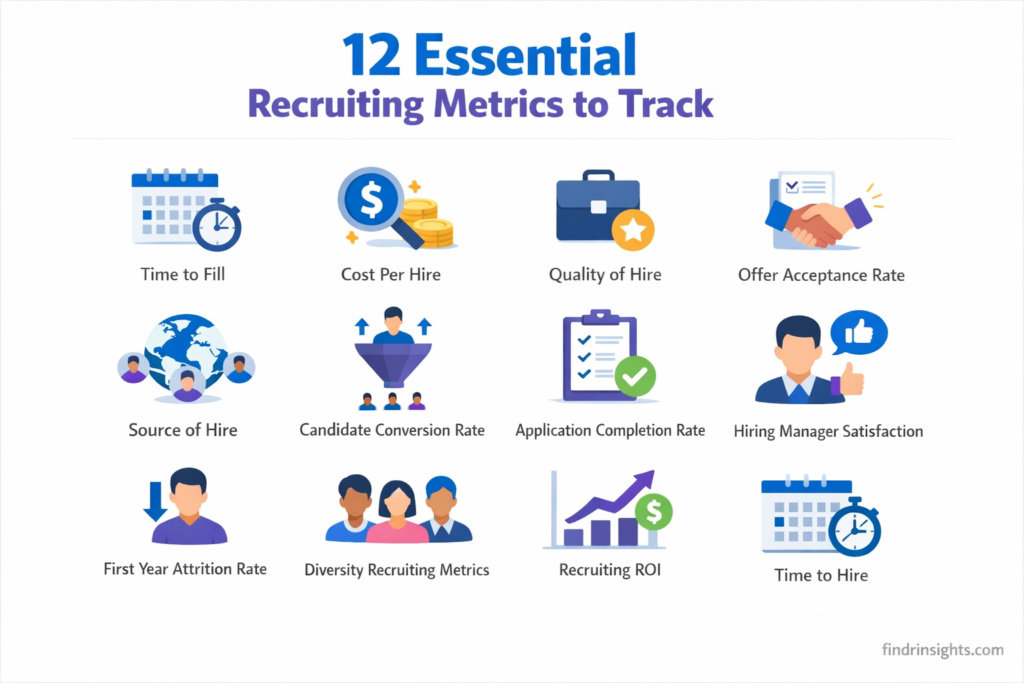
The 12 Most Important Recruiting Metrics to Track
Industry research reveals these 12 metrics deliver actionable insights. They balance operational efficiency with strategic impact, giving you visibility into process health and hiring outcomes. We selected these based on practitioner recommendations and proven correlation with recruiting success.
1. Time to Fill
Time to fill measures the days between opening a job requisition and a candidate accepting your offer. Unlike time-to-hire, which tracks from first candidate contact to acceptance, time-to-fill captures your entire recruiting cycle and serves as your core efficiency indicator.
Why it’s a key recruiting metric: When sales roles sit empty, deals die, while missing engineers delay product launches. Meanwhile, slow processes lose top talent to competitors who move faster.
How to measure recruiting metrics: Time to Fill = Day Offer Accepted – Day Requisition Opened
Recruiting metrics benchmarks: US companies average 44 days. Technical roles stretch to 60+ days, entry-level fills in 30-35 days.
Improvement tips:
- Build talent pipelines before you need them
- Streamline approval processes to reduce administrative delays
- Use applicant tracking systems to automate scheduling
2. Cost per Hire
Cost per hire calculates total recruiting expenses divided by hires. Internal costs include recruiter salaries, ATS software, and interview time. External costs cover job boards, agencies, background checks, and advertising.
The average US cost per hire is $4,700, though small businesses often spend $3,000-$4,000 while enterprises may exceed $6,000.
Cost components:
| Internal Costs | External Costs |
| Recruiter salaries | Job board subscriptions |
| Hiring manager time | Agency fees |
| Interview coordination | Background checks |
| Onboarding materials | Advertising spend |
Optimization strategies:
- Focus budget on high-performing sources
- Leverage employee referrals that deliver better hires at lower cost
- Track cost-per-hire by source to identify waste
3. Quality of Hire
Quality of hire measures the value new employees bring. It’s one of the most important recruiting metrics because it connects talent acquisition to business performance.
Why it matters: This determines whether your investment pays off. A fast, cheap hire who underperforms costs far more than a thorough process of landing the right person.
Multiple workforce studies converge on the same conclusion: bad hires are far more expensive than most businesses expect.
While the commonly cited benchmark places first-year turnover costs at roughly 30% of salary, deeper analyses show a significantly higher impact.
SHRM estimates that replacement costs alone reach 50–60% of an employee’s salary. When lost productivity, morale damage, and downstream turnover are included, total costs often rise to 90–200% of salary, up to four times annual pay in some roles.
CareerBuilder’s surveys support this range, with 74% of employers reporting that a single bad hire costs at least $2,500, and many exceeding $10,000 per incident.
Poor hiring decisions are linked to the majority of voluntary turnover, and average losses per bad hire approach $17,000 across roles. Quality hiring is not a soft HR concern—it is a direct driver of cost control, retention, and operational stability.
Measurement methods: Calculate using performance scores, retention, and manager satisfaction. Common formula: Quality of Hire = (Performance Rating + Retention Score + Manager Satisfaction) / 3. Performance comes from 90-day reviews, and retention tracks whether they stay past year one.
Improvement levers:
- Implement skills assessments during screening
- Conduct structured interviews with consistent questions
- Complete reference checks to reveal performance patterns
- Define success criteria with hiring managers before posting roles
4. Offer Acceptance Rate
This tracks the percentage of offers candidates accept. Low rates signal compensation, brand, or experience problems. High rates indicate your offers compete effectively.
What it measures: Acceptance reveals whether your value proposition resonates. Consistent declines mean you’re targeting wrong people or failing to sell why they should join. When rates drop below 75%, you need immediate investigation, while strong teams maintain 85-90% acceptance.
How to improve candidate experience:
- Set clear compensation expectations early
- Communicate timeline after every interview
- Personalize offers to address what matters—flexibility, growth, or benefits
- Survey declined candidates to understand what’s driving them to competitors
5. Source of Hire
Source of hire tracks which channels deliver hires—job boards, referrals, social media, agencies, or direct sourcing. Source-of-hire data reveals where to invest time and budget.
Social recruiting metrics vs traditional sources: Social recruiting generates higher engagement but longer conversion. Job boards produce volume quickly but may sacrifice quality.
Referrals consistently deliver better retention. The gap between volume and quality becomes clear in the data: job boards and social sites account for 49% of applications but only 24.6% of hires.
Source performance comparison:
| Source | Volume | Quality | Cost |
| Employee Referrals | Low | Highest | Lowest |
| Job Boards | Highest | Variable | Medium |
| LinkedIn/Social | Medium | High | Medium-High |
| Agencies | Low | Variable | Highest |
Optimization tactics:
- Double down on sources delivering quality hires
- Build referral programs rewarding employees
- Track conversion rates by source to identify drop-off points
6. Candidate Conversion Rate
Funnel-based metrics show how candidates move through hiring stages, revealing bottlenecks where qualified people exit.
How to measure recruitment effectiveness: Calculate conversion at each stage: applications to screens, screens to interviews, interviews to offers. If 100 apply but only 3 reach interviews, you’re attracting wrong candidates or screening too aggressively.
Funnel table example:
| Stage | Candidates | Conversion Rate |
| Applications | 100 | – |
| Phone Screens | 15 | 15% |
| First Interviews | 8 | 53% |
| Final Interviews | 3 | 38% |
| Offers Extended | 2 | 67% |
| Offers Accepted | 2 | 100% |
Improvement actions:
- Optimize job descriptions to attract qualified candidates only
- Add qualifying questions to applications
- Investigate sharp drops at specific stages to identify misaligned requirements
7. Time to Hire
Time to hire differs from time to fill. While time to fill tracks requisition to acceptance, time to hire measures from first candidate contact to offer acceptance, showing how efficiently you move people through your process.
Why recruiters track both: Time to fill indicates overall process health. Time to hire reveals candidate experience quality. Long time to hire risks losing engaged candidates, a concern that’s intensified as recruiters now manage 56% more open positions than three years ago.
Benchmarks and improvement strategies:
- Maintain 14-21 day time-to-hire for competitive positioning
- Schedule interviews within 3-5 days of application
- Use automated scheduling tools
- Implement standardized interview guides
8. Application Completion Rate
This measures what percentage of started applications get submitted. Low completion indicates friction—too many fields, unclear instructions, or glitches.
Candidate experience signal: The problem is widespread across companies. When only 6% of people who click “apply” actually complete applications, you’re losing the vast majority of interested candidates mid-process. When you improve completion from 60% to 75%, you gain 25% more candidates without increasing spend.
How it impacts recruiting metrics reporting: Application completion affects all downstream metrics. Low completion shrinks your candidate pool, reducing quality and increasing time-to-fill.
Optimization checklist:
- Reduce required fields to essentials only
- Enable one-click apply with LinkedIn or Indeed
- Test application on mobile devices
- Remove unnecessary screening questions
- Save progress so candidates can return later
9. Hiring Manager Satisfaction
Qualitative metrics capture stakeholder perception. Hiring manager satisfaction reveals whether recruiting delivers what internal customers need—right candidates, right time, right experience.
How to quantify satisfaction: Survey managers quarterly using Net Promoter Score methodology. Rate recruiting responsiveness, candidate quality, and efficiency on a 1-10 scale.
Improvement framework:
- Meet with managers before posting roles to align on requirements
- Provide realistic timelines based on time-to-fill data
- Investigate satisfaction dips to identify root causes in quality, speed, or communication
10. First-Year Attrition Rate
First-year attrition tracks how many new hires leave within 12 months. High attrition signals recruiting problems—misrepresenting roles, missing cultural fit, or failing to assess qualifications.
Why it matters for recruiting metrics analytics: This metric reveals the true cost of hiring missteps. Every early departure costs 30% of annual salary in replacement, lost productivity, and wasted onboarding.
Link to quality of hire: This directly impacts quality calculations. A six-month departure delivered negative value regardless of initial performance. Since attrition directly impacts quality calculations, examining which sources bring people who stay versus those who leave early reveals channel effectiveness.
Benchmarks and fixes:
- Aim for sub-20% first-year attrition to beat the 20% industry average
- Improve job description accuracy to set realistic expectations
- Implement realistic job previews during interviews
- Strengthen onboarding to set new hires up for success
11. Diversity Recruiting Metrics
Diversity metrics track representation across demographic groups throughout your hiring funnel, ensuring inclusive practices that bring varied perspectives.
What diversity recruiting metrics track: Monitor applicant, interview, and hire diversity across gender, race, and age. Compare workforce demographics to available talent pool. Track pass-through rates to identify where diverse candidates exit disproportionately.
Legal-safe measurement approach: The legal approach requires collecting demographic data through voluntary self-identification after hire decisions. Legal compliance demands that you avoid using protected characteristics in hiring decisions. Instead, focus on process fairness by tracking whether diverse candidates advance at similar rates.
Social recruiting metrics tie-in: Platforms like LinkedIn allow targeting to reach underrepresented groups. Partner with organizations specializing in diverse talent pipelines. Review job descriptions for biased language.
Improvement actions:
- Diversify interview panels
- Remove unnecessary degree requirements
- Audit compensation for pay equity
- Track retention by demographic group
12. Recruiting ROI
Recruiting ROI is a strategic metric executives use to evaluate talent acquisition value. It connects total recruiting investment to business outcomes like revenue growth, productivity gains, or reduced turnover costs.
Formula overview: ROI = (Value of Hires – Cost of Hiring) / Cost of Hiring × 100. Value comes from new hire productivity, revenue contribution, or reduced turnover costs. Example: $50,000 in recruiting costs producing $200,000 in value equals 300% ROI.
Why leadership cares: Every recruiting dollar competes with sales, marketing, and product investment. Proving ROI secures budget for tools and programs that improve outcomes.
Improvement levers:
- Reduce cost-per-hire by optimizing source mix
- Increase value by improving quality through better assessment
- Shorten time-to-productivity with stronger onboarding linked to startup costs planning
Top 5 Recruiting Metrics for Small and Mid-Sized Businesses
Small businesses need simplified tracking focused on immediate impact. Instead of attempting to track every possible recruiting metric, which creates reporting burden without insight, focus on the measurements that address your specific challenges.
Top 5 recruiting metrics for SMBs:
- Time to Fill: Directly impacts your ability to capitalize on growth opportunities when every role matters to revenue generation.
- Cost per Hire: Controls budget when every dollar counts and recruiting competes with operational expenses.
- Quality of Hire: Ensures limited hiring capacity goes to people who perform, not just bodies filling seats.
- Offer Acceptance Rate: Reveals whether compensation and brand compete locally in your specific talent market.
- Source of Hire: Focuses limited resources on channels that deliver results rather than spreading budget across untested sources.
These five give visibility into speed, cost, and quality without requiring dedicated analytics teams. Establish a rhythm of monthly tracking with quarterly reviews and trend-based adjustments to maintain consistent measurement without overwhelming your team.
Recruiting Metrics Examples and Sample Reports
Recruiting Metrics Sample Report
A functional report includes current period data, prior period comparison, and benchmarks. Present numbers in context—time-to-fill increased 12 days (current: 48, prior: 36, benchmark: 44) signals problems.
Key data points included: Total requisitions opened and closed, average time-to-fill by department, cost-per-hire with source breakdown, quality-of-hire scores for recent hires, offer acceptance rates, and narrative context explaining significant changes and planned responses.
Recruiting Metrics Examples by Role
Recruiter-level metrics: Individual recruiters track requisitions managed, candidates sourced, time-to-fill, and hiring manager satisfaction. These individual-level metrics reveal performance patterns and training needs.
Hiring manager-level metrics: Managers see candidate quality scores, time from interview to decision, and feedback completion rates.
Executive-level metrics: Leadership reviews recruiting ROI, diversity hiring progress, and how recruiting supports revenue goals. The focus at this level is business impact rather than operational details.
Recruiting Metrics Benchmarks: What “Good” Looks Like
Industry benchmarks provide context for your numbers. US recruiters handle 55 hires per month—81% above global average. Time-to-fill benchmarks range from 30 days for entry-level to 60+ for specialized roles.
What are good recruiting metrics: The answer is contextual. What constitutes success varies by industry, size, and labor market. A 44-day time-to-fill might be excellent in healthcare but problematic in retail. Cost-per-hire of $4,700 works for skilled positions but indicates inefficiency for hourly roles. Benchmarks guide improvement but shouldn’t override business context—if your time-to-fill is 50 days but you’re hiring quality people who stay, that beats a 30-day average with 40% attrition.
How to use benchmarks correctly: Identify metrics where you significantly lag, then investigate root causes and use those insights to set realistic targets. For example, if the industry average is $4,700 and yours is $8,000, aim for $6,000 as an interim goal rather than attempting to match the benchmark immediately.
How to Measure Recruiting Metrics Accurately
Accurate measurement requires consistent data capture and clear, well-documented definitions across all recruiting activities. Define exactly when time-to-fill starts—is it requisition approval or when you post the job? When definitions shift between reporting periods, you lose the ability to track trends or make meaningful comparisons.
Define metrics clearly: Establish start and end points for time-based metrics, include all relevant costs in cost-per-hire calculations, and segment data by role type for meaningful comparisons.
Identify data sources: Pull data from your applicant tracking system for complete candidate flow and detailed timelines. Payroll systems provide detailed cost data. Performance management systems supply quality indicators including ratings and reviews. Surveys capture satisfaction metrics from hiring managers and candidates.
Set reporting cadence: Track operational metrics like applications and phone screens weekly to spot immediate issues and process bottlenecks quickly. Review strategic metrics like quality-of-hire and retention quarterly to identify longer-term patterns. Annual reviews identify multi-year trends and inform pricing strategy adjustments for recruiting budgets.
Avoid common errors: Including cost categories inconsistently across periods, failing to account for role difficulty when comparing time-to-fill, and measuring quality too early before new hires demonstrate performance all corrupt your data.
Accuracy checklist:
- Define start and end points for time-based metrics clearly
- Include all relevant costs in cost-per-hire calculations
- Segment data by role type and level for meaningful comparisons
- Validate ATS data against actual hire dates and costs
- Document methodology so measurement stays consistent over time
Recruiting Metrics Templates and Dashboards
Recruiting Metrics Template (Excel)
A recruiting metrics Excel template should track core KPIs with automatic calculations. Include tabs for monthly data entry, comparisons, and visual charts showing trends.
Template structure:
| Tab Name | Contents | Update Frequency |
| Monthly Data | Raw numbers: hires, costs, days | Weekly |
| Calculations | Formulas: CPH, TTF, acceptance rate | Auto-calculated |
| Trends | Charts: 12-month rolling averages | Auto-updated |
| Benchmarks | Industry standards by role type | Quarterly review |
Recruiting Metrics Dashboard
A recruiting dashboard visualizes data for quick pattern recognition. Show time-to-fill trending over 12 months, cost-per-hire by source in bar charts, and quality-of-hire scores with performance color-coding.
Visualization best practices: Line charts show trends over time. Bar charts compare categories like sources or departments. Gauge charts show metrics against benchmarks. Update weekly.
Tools commonly used in the US market: Greenhouse, Lever, and SmartRecruiters offer built-in analytics. Smaller teams use Google Data Studio or Excel dashboards.
Mistakes Companies Make When Tracking Recruiting Metrics
Vanity Metrics
Application volume looks impressive but means nothing if conversion rates are terrible. Tracking metrics simply because they look good in presentations creates reporting burden without insight. Focus on metrics that drive decisions rather than numbers that impress stakeholders.
Tracking Too Many Metrics
Many teams try measuring everything and end up analyzing nothing. The solution is focus: select 5-12 metrics aligned to your biggest hiring challenges. If your struggle is speed, prioritize time metrics. If it’s quality, emphasize performance and retention data.
Misaligned KPIs
Measuring recruiters purely on time-to-fill incentivizes rushing and sacrificing quality. Tracking only cost-per-hire encourages cheap hires who underperform. Balance metrics across speed, cost, and quality so teams optimize for overall hiring success.
Final Summary: Building a Metrics-Driven Recruiting Strategy
Great recruiting combines art and science. Metrics provide the science—objective feedback showing what works and what wastes resources. They reveal that referrals deliver better retention than job boards, or that candidates drop off because your application takes 30 minutes. Measurement replaces assumptions with concrete evidence pointing toward improvements.
Key recruiting metrics to track: Start with time-to-fill, cost-per-hire, and quality-of-hire. These three cover speed, efficiency, and outcomes. Layer in the source-of-hire and offer acceptance rate. Add strategic metrics like diversity and ROI as you mature.
Emphasis on improvement, not reporting: Measurement without action wastes effort. The real value comes from acting on what you learn. If time-to-fill is too high, streamline approvals and build talent pipelines. If certain sources consistently deliver poor retention, redirect budget elsewhere. When offer acceptance drops, survey declined candidates to understand what’s driving them to competitors. Metrics only create value when they drive smarter decisions.
The businesses winning the talent war aren’t necessarily spending more or moving faster. They’re using data to recruit strategically, placing the right people in the right roles while competitors guess their way through hiring. They know which job boards waste money and which deliver quality.
When you’re just starting your business, every hire carries outsized impact. The wrong person in a critical role can derail growth for months. Recruiting metrics help you make those crucial hiring decisions based on evidence rather than gut feel.
Start tracking these 12 metrics today by setting baselines, identifying the one or two metrics where improvement would have the biggest impact, and building simple dashboards that make patterns visible. Review your data monthly and adjust your recruiting approach based on what you learn.
Remember that metrics aren’t about perfection—they’re about progress. You don’t need enterprise analytics or dedicated recruiting ops teams.
You need clarity on what matters, consistency in measurement, and commitment to acting on insights.
Data-driven decision-making allows small businesses to compete for talent and transforms recruiting from a necessary cost into a competitive advantage.