Once you’re past the startup phase with revenue coming in, growing a business isn’t about working harder; it’s about building systems that multiply your impact.
This guide walks you through the five pillars that separate businesses stuck at their current size from those that scale successfully.
You’ll learn exactly how to grow a business, when to prioritize acquisition over retention, how to avoid the cash flow traps that kill 50% of businesses by year five, and why planning your exit today makes your business more valuable tomorrow.
Key Takeaways:
- Growth requires systematic execution across five interconnected pillars, not isolated tactics
- Your revenue stage determines which growth strategies work and which waste resources
- Most growth failures stem from scaling before systems are ready, not from lack of opportunity
- Exit-ready businesses outperform peers during growth phases by 25-95%
Business Growth vs. Business Scaling
What Is Business Growth
Business growth means increasing your revenue and resources at roughly the same rate. When you hire five salespeople to handle five new accounts, you’re experiencing classic linear growth where more inputs create proportionally more outputs. Your costs rise proportionally with your income through this linear expansion model.
This early phase focuses on building the foundation, establishing market presence, and proving your business model works before you can achieve the leverage that comes with scaling. Early growth requires near-equal investment. Each new revenue dollar costs $0.80–$1.00 to generate as you work to validate your approach.
What Is Business Scaling
Scaling happens when your revenue increases faster than your costs. You serve 100 new customers using the same infrastructure that handled 50. Your profit margins expand because you’ve built systems that leverage your existing resources.
Scaled businesses use technology, automation, and optimized processes to multiply output without multiplying headcount.
A software company serving 10,000 users doesn’t need ten times the staff of one serving 1,000 users. This multiplier effect, where you serve more customers without proportionally increasing costs, defines true scaling.
Growth vs. Scaling: Quick Comparison
Growth:
- Revenue ↑, Costs ↑ proportionally
- Add resources to add capacity
- Linear expansion model
- Necessary foundation phase
Scaling:
- Revenue ↑↑, Costs ↑ marginally
- Leverage existing infrastructure
- Exponential expansion model
- Systems-dependent phase
Growth vs. Scaling Across Business Stages
Early-stage businesses focus on growth by finding customers, building credibility, and stabilizing operations while proving the concept works. Mid-stage businesses transition to scaling by systematizing what works and eliminating bottlenecks. Late-stage businesses optimize scaled systems while preparing for either continued expansion or strategic exit.
The mistake most businesses make is trying to scale before they’ve grown enough to know what works, or they keep growing linearly when they should be building scalable systems.
The Five Pillars of Business Growth
Pillar 1: Customer Acquisition
Customer acquisition systems transform your business from referral-dependent luck into predictable, scalable growth by creating consistent pathways for turning strangers into paying customers.
This encompasses your marketing channels, sales processes, and conversion systems working together to create reliable revenue.
Effective acquisition requires knowing your customer acquisition cost (CAC), understanding which channels deliver the highest-quality leads, and knowing how to optimize your conversion rates at each funnel stage.
Pillar 2: Customer Retention
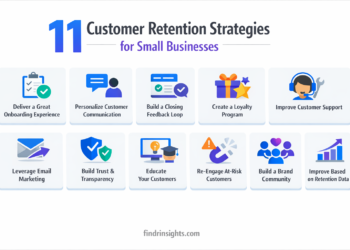
Retention determines whether you’re filling a leaky bucket or building a growing customer base. Acquiring customers costs five times more than retaining them, which means a 5% retention improvement can boost profits by 25–95%.
Retention requires delivering enough value that customers choose renewal over alternatives, transforming one-time buyers into long-term relationships.
Pillar 3: Brand and Market Positioning
Brand extends far beyond visual elements like logos; it’s the complete collection of associations people form with your business.
Strong positioning lets you charge premium prices, attract better customers, and reduce acquisition costs because prospects already understand your value.
Strong market positioning allows you to compete on value rather than price alone, elevating your business from commodity status toward category leadership.
Pillar 4: Operational Scaling
Operations determine your capacity ceiling. You can acquire all the customers you want, but if your systems can’t deliver consistently, you’ll damage retention and reputation.
Operational scaling means building infrastructure that handles 10x your current volume without 10x the costs.
This pillar separates businesses that grow successfully from those that collapse under their own expansion.
Pillar 5: Exit Strategy and Business Value
Exit readiness isn’t about planning to sell; it’s about building a business that could operate successfully without you.
Building a business that could operate successfully without you creates an ironic outcome: such businesses become so profitable and enjoyable to run that owners rarely need or want to sell them.
This pillar ensures your growth creates enterprise value, not just personal income.
Assessing Business Growth Readiness
Indicators of Growth Readiness
The clearest indicator of growth readiness appears when demand consistently exceeds your capacity, creating situations where customers wait for your product, you turn down work, or you extend delivery timelines because current operations can’t keep pace with market interest.
Financial readiness means positive cash flow for at least six consecutive months and reserves covering 3-6 months of operating expenses.
Your unit economics must be proven. You know exactly how much it costs to acquire and serve each customer, your customer lifetime value (LTV) exceeds CAC by at least 3:1, and those numbers are sustainable across your customer base.
Operational readiness shows in systematized procedures, a capable team beyond just you, and systems that don’t break when volume increases by 20%. You’ve validated your business idea with real customers paying full price, not friends buying to support you.
Market readiness appears when competitors confirm demand by entering your space, when industry trends favor your solution, and when customers describe a clear problem your business solves.
Indicators of Growth Risk
Inconsistent revenue signals you haven’t found product-market fit. If monthly income fluctuates wildly without seasonal explanation, you’re not ready to scale because you’re still searching for what works.
When you’re the only person capable of closing sales, delivering service, or handling customer issues, you can’t scale because you’ve effectively built a job rather than a business. This founder dependency becomes a growth killer.
Businesses with negative or barely positive margins must address their unit economics before pursuing expansion, since growth would only accelerate the path to bankruptcy. Every new sale either loses money or generates insufficient profit to reinvest in the business.
Customer concentration risk appears when losing your top three customers would destroy the business. If 50% or more of revenue comes from a handful of accounts, you’re vulnerable because one cancellation could trigger collapse.
Growth Readiness Assessment Tool
Calculate your readiness score across these dimensions:
- Financial stability (cash reserves, profit margins, revenue consistency)
- Operational capacity (written systems, team capability, delivery scalability)
- Market validation (customer demand, competitive position, market trends)
- Strategic clarity (defined growth objectives, resource availability, risk management)
If three of four dimensions score strong, you’re ready. Two strong dimensions means you need more foundation work. One or fewer means focus on survival and stability before considering expansion.
Pillar 1 — Customer Acquisition Systems
Customer Acquisition Fundamentals
A healthy LTV:CAC ratio requires at least 3:1, indicating that customers generate sufficient lifetime value to justify acquisition costs and provide sustainable margins. Your LTV:CAC ratio determines acquisition sustainability.
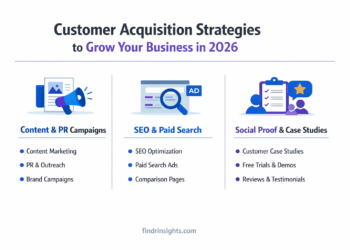
Acquisition channels fall into three categories: owned (your website, email list), earned (word-of-mouth, PR, organic social), and paid (ads, sponsored content). Since over-reliance on any single channel creates vulnerability to algorithm changes, policy shifts, or competitive disruption, successful businesses diversify acquisition across owned, earned, and paid channels.
Conversion rate optimization matters more than traffic volume. Doubling your conversion rate from 2% to 4% has the same impact as doubling your traffic, but costs far less. Focus on testing messaging variations, simplifying the buying process, and systematically removing friction points that prevent prospects from converting.
Digital Marketing Strategy
With acquisition fundamentals clear, execution depends on channel selection. Digital marketing divides into owned, earned, and paid strategies, each requiring different approaches.
Search Engine Optimization
Your sales funnel maps the customer journey from awareness to purchase. Top of funnel (TOFU) attracts strangers through content, social media, and search visibility. Middle of funnel (MOFU) nurtures interest through email sequences, case studies, and product education. Bottom of funnel (BOFU) converts ready buyers through demos, trials, and sales conversations.
SEO drives long-term acquisition by ranking your content where prospects search. Identify keywords your customers use, create comprehensive resources addressing those searches, and optimize your site’s technical foundations. SEO compounds because content created today generates traffic for years.
Email Marketing Fundamentals
Email marketing delivers the highest ROI of any digital channel because it owns the relationship while social media platforms merely rent it to you. Build your list through valuable lead magnets, segment subscribers by interest and behavior, and send relevant content that moves people toward purchase.
Social Media Approach
Social media works for awareness and community, not direct selling. Choose platforms where your customers actually spend time. Share insights, answer questions, and demonstrate expertise. Social followers become email subscribers become customers, though they rarely skip steps in this progression.
Content Strategy
Content marketing attracts prospects by answering questions they’re already asking. Start with written guides for SEO foundation, add video for engagement depth, then validate with case studies. The businesses that educate their market tend to dominate it.
Blog posts, videos, and podcasts establish authority while driving organic search traffic. Educational content attracts better prospects than promotional content because people search for solutions, not product pitches.
Long-form comprehensive guides outperform thin content. A single 3,000-word resource addressing a topic thoroughly drives more traffic and conversions than ten 300-word posts scratching the surface. Depth builds authority.
Video content engages differently than text. Product demos, customer testimonials, and educational walkthroughs help prospects visualize using your solution. Video doesn’t replace written content; it complements it by serving different learning preferences.
Case studies prove results. Prospects want evidence that your solution works for businesses like theirs. Document customer outcomes with specific metrics because “increased revenue 47%” carries more weight than “improved performance.”
Sales Strategy and Sales Operations
Pipeline management tracks prospects from first contact through closed deal, preventing opportunities from stalling while helping forecast revenue. Track how long prospects spend at each stage and where they typically drop off because those bottlenecks need fixing.
Standardized processes guide prospects through your methodology. Codify what successful salespeople do from first contact to closed deal so new hires can replicate proven approaches instead of inventing their own. Process doesn’t restrict creativity; it establishes a baseline that everyone can improve.
Lead qualification filters prospects by identifying serious buyers. Use frameworks like BANT (Budget, Authority, Need, Timeline) to focus on prospects who will actually purchase. Disqualifying poor fits is as important as pursuing good ones.
CRM systems coordinate execution by tracking every customer interaction, automating follow-up, and ensuring no one falls through cracks. CRMs provide visibility into pipeline health and salesperson performance.
Paid Advertising Channels
Google Ads captures high-intent searches. When someone searches “enterprise CRM software,” they’re actively shopping. Search ads put you in front of buyers ready to evaluate solutions, so start with exact match keywords targeting bottom-funnel searches.
While search ads capture existing demand, Facebook and LinkedIn ads excel at targeted awareness. Detailed demographic and behavioral targeting lets you reach specific customer profiles. Use these platforms to build audience awareness, then retarget engaged users with conversion-focused campaigns.
Retargeting ads follow website visitors across the internet, keeping your brand visible. Most buyers need multiple touchpoints before purchasing, and retargeting provides those touchpoints efficiently.
Measure every ad campaign on CAC, not clicks or impressions. Platforms optimize for engagement; you optimize for profitable customer acquisition. Track actual revenue generated per dollar spent.
ACQUISITION QUICK AUDIT
Channel Health:
- ✓ CAC < 1/3 LTV across all channels
- ✓ 3+ validated acquisition sources active
- ✓ No single channel represents >50% of new customers
Conversion Optimization:
- ✓ Funnel conversion tracked at each stage
- ✓ A/B testing program running continuously
- ✓ Lead qualification framework in use
Sales Infrastructure:
- ✓ CRM system capturing all interactions
- ✓ Pipeline visibility updated weekly
- ✓ Sales playbook written and followed
Pillar 2 — Customer Retention and Lifetime Value
Why Retention Drives Growth
Retention impacts every growth metric. A business keeping 95% of customers monthly versus 85% creates dramatically different economics. This difference compounds dramatically over time: across twelve months, a business retaining 95% of customers monthly maintains 54% of its original customer base, while 85% monthly retention leaves only 14% remaining.
When customers stay longer, each acquisition dollar generates greater lifetime value, shortening your CAC payback period and freeing cash for additional growth investments. High retention multiplies acquisition effectiveness.
Existing customers spend 31% more than new ones and are 50% more likely to try new products. Your growth doesn’t require constantly finding new customers; it comes from selling more to the ones you have.
Retention Strategy Framework
Customer segmentation lets you treat different customer types appropriately. High-value customers deserve white-glove service. Price-sensitive customers need efficient, low-touch experiences. Segment by value, behavior, and needs, then customize your approach accordingly.
Onboarding determines whether new customers succeed or churn. The first 30 days are critical, so guide them to their first win quickly and show them how to extract value immediately. Customers who achieve early success stay longer.
Customer success programs proactively ensure customers achieve their goals. Don’t wait for problems; reach out regularly to identify obstacles and provide solutions before customers consider leaving. Success teams prevent churn by catching issues early.
Feedback loops capture customer insights systematically. Survey customers at key moments: after purchase, after onboarding, quarterly for long-term clients. Use feedback to improve product, service, and experience continuously.
Email Marketing for Retention
Email remains the highest-leverage retention channel because it maintains relationships between purchases.
Start with lifecycle automation that triggers based on customer actions: welcome series for new customers, renewal reminders before subscriptions expire, and win-back campaigns for churned customers. Automation ensures no customer falls through the cracks.
Layer in behavioral personalization using customer data to send relevant messages based on purchase history, browsing behavior, and stated preferences. Generic broadcasts get ignored; personalized messages get read.
Balance promotional content with educational value. Share insights, answer common questions, and help customers succeed. Value-first emails build trust that makes promotional messages effective.
Customer Experience Optimization
Response speed shapes customer perception more than resolution quality in the first 24 hours. Set expectations clearly and meet them consistently because a 24-hour response window works if you hit it 100% of the time.
Omnichannel support lets customers reach you how they prefer: phone, email, chat, or social media. Integrate channels to maintain conversation continuity when customers switch platforms, preventing the frustration that drives churn.
Beyond reducing support burden, self-service resources improve experience for the significant segment of customers who prefer solving issues independently rather than contacting support. Knowledge bases, FAQs, and video tutorials let customers solve common issues instantly.
Proactive communication prevents problems. Notify customers about potential issues before they discover them and explain delays before deadlines are missed. Taking responsibility and communicating clearly builds loyalty even when things go wrong.
Core Retention Metrics
These metrics interconnect to show retention health. Customer churn rate is the percentage of customers who leave in a given period. Calculate monthly: customers lost divided by total customers at period start. Aim for under 5% monthly churn for subscription businesses.
Lower churn increases LTV, which improves Net Revenue Retention (NRR) when combined with expansion revenue.
NRR measures revenue from existing customers, including upsells, cross-sells, and churn. An NRR over 100% means existing customers generate more revenue over time. Best-in-class SaaS companies achieve 120%+ NRR.
LTV is average revenue per customer multiplied by average customer lifespan. If customers pay $100 monthly and stay 24 months average, LTV is $2,400.
RETENTION HEALTH CHECK
Churn Management:
- ✓ Monthly churn rate under 5%
- ✓ Churn reasons tracked and categorized
- ✓ At-risk customer alerts automated
Customer Success:
- ✓ Onboarding achieves first value within 7 days
- ✓ Quarterly business reviews scheduled for top accounts
- ✓ Product adoption metrics monitored
Revenue Expansion:
- ✓ NRR above 100%
- ✓ Upsell/cross-sell programs active
- ✓ Customer feedback loop established
Pillar 3 — Brand and Market Positioning
Why Brand Drives Growth Leverage
Strong brands reduce acquisition costs. Prospects already trust you before first contact because they’ve seen your content, heard recommendations, and formed positive associations. Trust shortens sales cycles and increases conversion rates.
Premium pricing follows strong positioning. Commodities compete on price while brands compete on value. When customers understand what makes you different and better, they’ll pay more for it.
Brand equity compounds over time. Every customer interaction, piece of content, and delivery reinforces or weakens your position. Consistent excellence builds reputation that becomes your most valuable asset.
Talent acquisition improves with strong brands. Top performers want to work for companies with clear missions and strong reputations, giving brand strength competitive advantage in hiring.
Brand Development
Brand positioning defines how you’re different from competitors in ways customers care about. It’s not about what you do; it’s about the specific value you create that others don’t. Positioning answers: “Why should I choose you instead of any alternative?”
Messaging clarity ensures everyone understands your value proposition immediately. Can someone explain what you do and why it matters in one sentence? Complex explanations suggest unclear positioning.
Visual identity creates recognition through logo, colors, typography, and design standards that ensure consistency across all touchpoints. Consistency builds familiarity, and familiarity builds trust.
Brand voice determines how you communicate. Formal or conversational? Technical or accessible? Choose a voice matching your audience and position, then maintain it consistently across all content.
When promises and delivery align, brand strength compounds over time, but misalignment between what you say and what you deliver destroys trust faster than any other factor. Customer experience is your brand promise in action. Brand is what you say; experience is what you deliver.
Market Positioning Strategy
Brand development establishes identity; market positioning determines competitive placement within your category.
Category leadership means owning a specific market position. Volvo owns safety. FedEx owns overnight reliability. If you can’t clearly identify what position you own in customers’ minds, the specific association that makes you their default choice, your positioning needs refinement.
Competitive differentiation identifies what makes you specifically better for your target customer. Differentiation isn’t about being better at everything; it’s about being distinctly superior at what your customers value most.
Niche focus beats broad positioning for most businesses. Serving everyone means standing out to no one, so own a specific segment completely rather than chasing entire markets. Riches are in niches because specificity creates clarity.
Adjust positioning as customer sophistication increases. Early markets need education about the category while mature markets need differentiation from competitors. Adapt your message as understanding grows.
Pricing Strategy for Growth
Value-based pricing ties price to customer outcomes rather than costs. If your solution saves customers $50,000 annually, charging $15,000 captures value while delivering 3x ROI. Cost-plus pricing ignores the value you create.
Price positioning signals quality. Pricing below competitors suggests inferior quality while premium pricing implies superior value. Your price point communicates your market position before prospects experience your product.
Pricing tiers serve different customer segments. Basic plans attract price-sensitive buyers while premium tiers serve customers valuing advanced features and support. Anchoring with a high-tier price makes mid-tier pricing seem reasonable.
Test pricing regularly because small increases often improve profitability dramatically with minimal churn impact. A 10% price increase on a product with 50% margins doubles profit if you retain 95% of customers. Many businesses underprice their value significantly.
Pillar 4 — Scaling Business Operations
Operational Constraints to Growth
These constraints demand systematic responses. Manual processes create hard capacity ceilings: if you can personally handle only 20 sales calls weekly, you’ve capped your business at 20 weekly sales regardless of market demand, making automation essential to break through capacity constraints.
Bottlenecks appear where volume exceeds processing capacity. Orders pile up waiting for approval while support tickets languish in queues. Identify your biggest bottleneck because fixing it immediately increases capacity.
Rapid expansion that strains delivery quality can poison acquisition efforts entirely, as even a single poor customer experience spreads through reviews and word-of-mouth to undermine your reputation. Quality inconsistency damages growth, so scale quality as aggressively as you scale volume.
Scaling Operations Framework
Scaling operations requires written procedures to maintain consistency during expansion.
Process documentation eliminates dependency on institutional memory, reducing training time and error rates. When knowledge lives in systematized procedures rather than individual heads, new team members deliver results immediately instead of spending months learning tribal knowledge.
Standard operating procedures (SOPs) ensure repeatability. SOPs define exactly how to complete tasks from start to finish, allowing new team members to follow them and deliver consistent results from day one.
Technology infrastructure must handle 10x current volume. Your systems should feel underutilized because running at 90% capacity means you’re one surge from crashing. Build excess capacity into technology, warehouse space, and production capability.
Team structure scales through layers. You can directly manage 5-7 people effectively, but beyond that, you need middle management. Don’t resist organizational structure; it enables scale because flat organizations become bottlenecks past 15-20 people.
Quality control systems catch errors before reaching customers. Checklists, peer reviews, and automated testing maintain standards as volume increases because prevention costs less than correction.
Business Expansion Strategies
Choose geographic expansion when local market share exceeds 20%. Start locally, prove the model, then expand regionally because each new geography brings regulatory, cultural, and operational complexity. Expand methodically, not impulsively.
Add products when customer concentration risk is low. Product line extension serves existing customers with complementary offerings. If you sell software, add training services; bakeries add catering. Leverage existing customer relationships by solving adjacent problems.
Market diversification reduces customer concentration risk. Serving multiple industries or customer segments protects against downturns in any single market, so balance focus with prudent diversification.
Strategic partnerships accelerate expansion without proportional investment. Partner with businesses serving your target market with complementary offerings because co-marketing, referral agreements, and white-label arrangements create win-win growth.
Reference proven approaches for generating new business ideas when exploring expansion opportunities.
Operational Scaling Priorities
Identify your primary constraint first, then fix it. The Theory of Constraints says every system has one primary bottleneck limiting throughput; once removed, the next constraint becomes visible.
Document current processes before improving them. Systematize before you optimize because creating written protocols provides a baseline for enhancement. Optimizing chaos just makes faster chaos.
Build infrastructure ahead of demand. Technology, space, and systems require implementation time, so plan six months ahead so infrastructure is ready when growth arrives rather than scrambling when it’s already here.
OPERATIONS SCALING CHECKLIST
Process Foundation:
- ✓ Core workflows documented in SOPs
- ✓ Quality control checkpoints implemented
- ✓ Training materials created for all roles
Capacity Planning:
- ✓ Systems running under 70% capacity
- ✓ Infrastructure supports 3x current volume
- ✓ Bottlenecks identified and prioritized
Team Structure:
- ✓ Management layers defined beyond founder
- ✓ Decision-making authority delegated
- ✓ Organizational chart supports 2x headcount
Pillar 5 — Exit Strategy and Enterprise Value
Why Exit Readiness Improves Business Performance
Understanding valuation drivers reveals where to focus improvement efforts, whether you plan to sell or not.
Exit-ready businesses operate independently of their founders. Systems run smoothly without your daily intervention, teams make decisions autonomously, and customers stay because of the company, not personal relationships. This independence simultaneously improves profitability, reduces founder stress, and increases enterprise value.
Clean financials improve both sale readiness and operational decision-making. Transparent books, systematic procedures, and clear reporting enable better management while making businesses attractive to potential buyers.
Reducing owner dependency forces delegation and systematization. When you couldn’t sell because you’re indispensable, you’ve built a job requiring your presence daily. Exit readiness creates optionality: you could sell, but you don’t have to.
Business Valuation Fundamentals
Valuation Multiples by Industry
Valuation multiples vary by industry and size:
- Service businesses: 2-4x EBITDA
- SaaS companies: 5-10x revenue multiples
- Manufacturing: 4-6x EBITDA
Research comparable sales in your industry.
EBITDA (Earnings Before Interest, Taxes, Depreciation, and Amortization) is the standard profitability metric for valuations. It shows core business profitability independent of financing decisions and accounting methods.
Revenue Quality Factors
Revenue quality affects valuation:
- Recurring revenue valued higher than project-based work
- Diversified customer bases beat concentrated ones
- Long customer tenures signal stability
- Predictable businesses command premium valuations
Growth Impact on Price
Growth trajectory influences multiples significantly. Businesses growing 20%+ annually sell for higher multiples than flat or declining ones because buyers pay for future potential, not just current earnings.
Increasing Business Value
Reduce customer concentration. If your top five customers represent over 40% of revenue, you have concentration risk that reduces value because diversification increases business resilience and valuation.
Build management depth. Businesses run by strong teams beyond the founder sell for more, so develop leaders who can operate independently and codify decision-making frameworks so leadership isn’t dependent on founder instinct.
Create intellectual property. Patents, proprietary processes, brands, and customer data all increase value because IP creates competitive moats and sustainable advantages buyers pay premiums for.
Demonstrate growth potential. Buyers acquire future cash flows, so show them clear paths to expansion: underserved markets, new products, operational efficiencies not yet captured. Businesses with visible growth opportunities command higher multiples.
EBIT Associates’ 2025 analysis reports that 20-30% of businesses listed for sale actually sell, varying by factors like size, industry, pricing, and market conditions; smaller businesses with under five employees often fare worse due to poor records or owner dependency.
Companies with 3-5 years of advance planning typically achieve higher sale prices because they have time to address operational weaknesses and position themselves attractively.
Selling a Business
Preparation begins years before listing. Clean up financial records, systematize operations, and build management capability because the best time to prepare for sale is when you’re not planning to sell.
Business brokers and M&A advisors handle transactions professionally. They value businesses accurately, find qualified buyers, and negotiate deals.
Due diligence exposes everything. Buyers verify all claims through exhaustive investigation, so transparency from the start prevents nasty surprises.
Succession Planning Alternatives
Family succession keeps businesses in the family but requires capable successors interested in taking over.
Many family transitions fail because heirs lack the capability or interest, so honest assessment prevents disasters.
Management buyouts sell to existing executives who know the business intimately.
Financing can be challenging since managers rarely have capital to purchase, but seller financing or structured earnouts make deals possible.
Employee Stock Ownership Plans (ESOPs) sell to employees gradually while providing tax advantages. ESOPs work for profitable businesses with 20+ employees willing to participate.
Business Growth Metrics That Matter
Revenue and Profit Metrics
Monthly Recurring Revenue (MRR) shows predictable revenue from subscriptions and contracts. MRR enables accurate forecasting and demonstrates business health while growth in MRR indicates successful acquisition and retention.
Revenue growth rate measures expansion pace. Calculate year-over-year and month-over-month because sustainable growth rates vary by industry: 20-30% annually is strong for most businesses. Hockey stick projections usually indicate unrealistic planning.
Gross margin is revenue minus direct costs of goods sold. High margins provide funds for marketing, development, and profit, while improving margins by 5-10 percentage points can double profitability.
Net profit margin is what remains after all expenses. While top-line growth matters, profitability determines sustainability because businesses can’t lose money on every sale and make it up in volume.
Customer Metrics
Track CAC by channel to identify most efficient sources because rising CAC indicates acquisition challenges requiring attention.
LTV should exceed CAC by at least 3:1 for sustainable economics.
Churn rate measures the percentage of customers lost in a period. Track monthly and annually because high churn indicates product, service, or value problems requiring immediate attention.
Net Promoter Score (NPS) measures customer satisfaction and loyalty through the simple question, “How likely are you to recommend us?” Scores above 50 indicate strong satisfaction, and NPS correlates with growth and retention.
Operational Metrics
Revenue per employee shows operational efficiency. Higher revenue per employee indicates better leverage, while declining revenue per employee suggests inefficient scaling.
Order fulfillment time measures operational speed. Track from order placement to delivery because delays indicate operational constraints requiring process improvements.
Quality metrics (defect rates, customer complaints, and returns) highlight operational issues because quality problems always cost more to fix after customer delivery than before.
Common Business Growth Mistakes
Cash flow issues kill more growing businesses than any other factor.
Cash Flow Errors
Cash Flow Mismanagement
The fundamental distinction between revenue and cash creates problems for growing businesses; many sell products on payment terms, creating dangerous gaps between delivering value and receiving payment.
Profitable businesses fail when cash runs out before receivables arrive while inventory ties up cash, so balance needs with cash flow realities.
Customer Management Failures
Acquisition Without Retention
Chasing new customers while ignoring existing ones creates expensive treadmills. When you lose customers as fast as you acquire them, expansion stalls despite significant acquisition spending.
Ignoring Unit Economics
Unit economics show whether each sale creates or destroys value. When acquiring customers costs more than their lifetime value, growth accelerates losses rather than building equity.
Operational Missteps
Scaling Without Systems
When you land contracts exceeding your operational capability, quality inevitably suffers, reputation becomes damaged, and growth backfires into contraction. Premature scaling kills businesses by overwhelming capacity before operations are ready.
Founder Dependency
Building businesses requiring constant presence limits scale and creates exit barriers. Systematize operations, codify knowledge, and delegate authority to create value independent of your involvement.
Strategic Overreach
Overexpansion
Resource dilution prevents competitive depth in any single market. Expanding into too many markets simultaneously divides attention and resources, leaving you without the focus to excel anywhere.
Creating a 12-Month Business Growth Plan
Core Components of a Growth Plan
Current state assessment documents where you are financially, operationally, and strategically. Honest assessment identifies strengths to leverage and weaknesses requiring attention through review of revenue trends, customer metrics, operational capacity, and team capabilities.
Growth objectives define specific targets. Revenue goals alone are insufficient; set targets for customer acquisition, retention rates, margin improvement, and operational milestones. SMART goals (Specific, Measurable, Achievable, Relevant, Time-bound) create accountability.
Strategy selection identifies which growth pillars receive focus. You can’t optimize everything simultaneously, so choose 2-3 priorities aligned with current constraints and opportunities. Document why you’re pursuing specific strategies and what success looks like.
Quarterly milestones break annual goals into manageable increments. What needs accomplished each quarter to achieve annual objectives? Quarterly planning maintains focus while allowing strategy adjustments as circumstances change.
Resource allocation determines budget, team, and time investments for each initiative. Underfunded priorities fail, so allocate resources proportional to strategic importance.
Risk management identifies what could derail plans and how to mitigate those risks. Economic downturns, competitive threats, key personnel departures, and operational failures all threaten growth, so plan contingencies before crises emerge.
Review cadence establishes regular checkpoints for assessing progress. Monthly reviews track metrics against targets, while quarterly reviews assess strategy effectiveness and make adjustments. Annual reviews reset strategy based on lessons learned.
Quarterly Growth Review Process
- Performance comparison measures actual results against quarterly targets across all key metrics to identify variances and root causes.
- Strategy reinforcement doubles down on what’s working. When a channel or initiative exceeds expectations, increase investment.
- Strategy elimination cuts what’s failing because failed experiments deserve quick deaths, not prolonged life support.
- Priority adjustment responds to changing circumstances. Markets shift and opportunities emerge, so adapt quarterly based on current reality.
Business Growth Funding Options
Bootstrapped Growth
Self-funding maintains complete control and ownership. You reinvest profits to fuel expansion while growth proceeds at sustainable pace limited by cash generation. Bootstrapping forces discipline because you can’t outspend revenue.
Advantages include zero dilution, full decision authority, and no investor pressure for premature scaling. Disadvantages include slower growth and limited resources for significant opportunities.
Debt Financing
Loans and lines of credit provide growth capital without ownership dilution. Banks lend against assets and cash flow while SBA loans offer favorable terms for qualified businesses. Debt requires repayment regardless of performance; it increases risk but preserves ownership.
Revenue-based financing provides capital repaid as percentage of revenue. Flexible repayment aligns with business performance but can become expensive.
Equity Financing
Angel investors and venture capital trade ownership for growth capital. Equity financing provides significant resources plus advisor expertise while investors expect substantial returns, often 10x investment within 5-7 years.
Equity dilution means sharing ownership and control. Vet investors on sector experience, expected hold period, and governance expectations before accepting capital because wrong investors create conflicts that destroy businesses.
Capital Selection Criteria
Match funding source to growth opportunity. Debt works for proven models needing working capital while equity suits high-growth opportunities requiring significant investment before profitability.
Essential Business Growth Resources
Growth Toolkits and Templates
Growth planning templates provide frameworks for strategy development. Financial models help forecast scenarios and plan resource allocation while customer research templates systematize market feedback collection.
CRM systems track customers and sales pipeline. Analytics platforms measure website and marketing performance while project management tools coordinate team execution.
Recommended Business Growth Books
“Scaling Up” by Verne Harnish provides practical frameworks for growth execution. “Traction” by Gino Wickman offers implementation tools for systematizing businesses while “The Lean Startup” by Eric Ries teaches validated learning and rapid iteration.
Related Business Resource Hubs
Industry associations provide benchmarks, networking, and education specific to your sector. Small business development centers offer free consulting and training while online communities connect you with peers facing similar growth challenges.
For foundational business guidance, explore resources on starting a business.
Business Growth Roadmap by Revenue Stage
Foundation Stage ($0–$250K)
Priorities center on product-market fit validation and initial customer acquisition while you prove the concept works and people will pay. Focus on sales, customer feedback, and refining your offering.
Focus areas include establishing core operations, building initial customer base, and developing repeatable sales processes.
Key systems needed include basic bookkeeping, customer tracking, and service delivery processes. Document what works so you can repeat it consistently.
Growth Stage ($250K–$1M)
Acquisition and retention scaling become primary focuses. You’ve proven the model; now multiply it by investing in marketing channels showing positive ROI.
Team expansion brings specialized talent through hiring your first salespeople, marketing lead, and operations manager.
Core automation addresses repetitive tasks consuming excessive time. Implement CRM, marketing automation, and basic process automation.
Scaling Stage ($1M–$5M)
Operational leverage determines whether you scale profitably or chaotically. Systematize everything, build management layers, and invest in infrastructure supporting 3x current volume.
Market expansion introduces proven products to new segments or geographies. You’ve dominated initial market; now capture adjacent opportunities.
Value optimization focuses on margins, efficiency, and customer lifetime value. Revenue growth alone is insufficient; profitable growth requires margin expansion and efficiency improvements.
Maturity Stage ($5M+)
Profit maximization takes precedence over growth rate. You’ve established market position; now optimize returns through improved margins via operational excellence.
Exit readiness becomes strategic priority even if you’re not selling soon because building systems enables operation without you.
Strategic optionality means maintaining choices. You could sell, bring in investors, or continue as profitable independent business.
Key Business Growth Takeaways
Pillar alignment determines outcomes. Stellar acquisition efforts fail without retention systems while perfect operations can’t overcome weak positioning. Excellence requires competence across all five pillars.
Measurement precedes optimization. You can’t improve what you don’t measure, so track key metrics religiously because data reveals what’s working and where you’re wasting resources.
Readiness precedes scaling. Building systems before growth arrives prevents the chaos that kills expanding businesses because premature scaling fails more frequently than patient foundation-building.
GROWTH RISK SELF-ASSESSMENT
Mark any that apply to your business:
Financial Risks:
- □ Cash reserves < 3 months operating expenses
- □ Negative or sub-10% profit margins
- □ Monthly revenue fluctuation > 30% without seasonal cause
Customer Risks:
- □ Customer concentration > 40% from top accounts
- □ Monthly churn rate > 5%
- □ LTV:CAC ratio below 3:1
Operational Risks:
- □ Founder dependency in critical operations
- □ No written SOPs for core processes
- □ Systems running above 80% capacity
Strategic Risks:
- □ Unclear value proposition or positioning
- □ Single acquisition channel dependency
- □ No documented growth plan
If you marked 3+ items: Focus on stability before pursuing growth. If you marked 1-2 items: Address risks while executing controlled expansion. If you marked 0 items: You’re ready to scale aggressively.
Frequently Asked Questions
What is the difference between business growth and scaling?
Growth means increasing revenue and costs proportionally; you hire more people to serve more customers. Scaling increases revenue faster than costs by leveraging systems, technology, and processes. A growing business might double revenue by doubling headcount while a scaling business doubles revenue with only 30% more staff.
How fast should a small business grow?
Sustainable expansion rates vary by industry and stage. Early-stage businesses often grow 50-100% annually while establishing market presence. Mature businesses sustaining 15-25% annual growth are performing exceptionally. Prioritize durable expansion over speed because rapid scaling without systems collapses under its own weight.
When should a business focus on growth?
Focus on expansion after achieving product-market fit, positive unit economics, and operational foundation. You’re ready when customers repeatedly purchase, profit margins are healthy, and core systems can handle increased volume because growing before these foundations exist wastes resources and damages reputation.
Is customer acquisition or retention more important?
Both matter, but retention drives profitability because a 5% improvement in retention can boost profits 25-95%. Early-stage businesses prioritize acquisition to build customer base while established businesses achieve greater returns optimizing retention.
How much should a business spend on marketing?
B2B companies typically allocate 2-5% of revenue to marketing while B2C businesses spend 5-10%. High-growth companies may invest 20%+ to capture market share rapidly. The right number depends on CAC, LTV, and growth objectives, so measure marketing spend against customer acquisition results, not arbitrary percentages.
Should a business bootstrap or raise capital?
Bootstrap when you can fund growth profitably from operations because maintaining control and avoiding dilution benefits businesses with sustainable economics. Raise capital when market opportunity requires resources beyond operational cash flow to capture; winner-take-all markets often demand funded acceleration. Match funding strategy to competitive dynamics and growth timeline.
How do I know if my business is ready to scale?
You’re ready when demand exceeds capacity, unit economics are proven profitable, core processes are systematized and repeatable, and you’ve built a team capable of executing without constant founder intervention while cash reserves covering 3-6 months of operations provide safety buffer for scaling investments.
When should a business plan for an exit?
Start exit planning today regardless of actual exit timeline because businesses built for eventual sale operate better since they don’t depend on founder presence. Early planning provides time to address weaknesses, build value, and create optionality while most successful exits involve 3-5 years of preparation before listing.
Conclusion: Building a Scalable, Valuable Business
Growing a business successfully requires more than working harder; it demands systematic execution across five interconnected pillars. Master customer acquisition and retention, build brand positioning that commands premium pricing, scale operations to support 10x current volume, and create enterprise value independent of your daily involvement.
The businesses that scale successfully don’t chase every opportunity. They focus on building leverage, measure relentlessly and adjust based on data, and invest in foundations before pursuing growth requiring them.
Your business either grows intentionally through planned execution, or it plateaus while you work harder for the same results. The roadmap exists; implementation determines outcomes.