Learning to keep customers is crucial for growing your business and it is usually less expensive to retain customers than it is to acquire them. Customer retention strategies turn one-time buyers into loyal advocates who spend more, stay longer, and bring others along.
This guide covers 11 proven strategies for small businesses. You’ll learn what works across business models, how to implement each approach, and which delivers fast results.
Key Takeaways:
- Retention costs 5x less than acquisition and delivers higher margins
- A 5% retention increase can boost profits by 25-95%
- Combine quick wins (onboarding) with long-term investments (community)
- B2C focuses on experience, B2B on relationships, SaaS on adoption
What Are Customer Retention Strategies (Definition + Scope)
Customer retention strategies are systematic methods to keep existing customers engaged, satisfied, and buying repeatedly. They’re not one-off tactics but approaches to building relationships beyond single transactions.
Retention differs from acquisition. Customer acquisition brings customers in. Retention transforms them into repeat buyers and advocates. Acquisition focuses on awareness and conversion; retention centers on value delivery and sustained engagement.
Benefits of Customer Retention Strategies for Small Businesses
In some e‑commerce sectors, customer acquisition costs combined with returns and other expenses have increased drastically, with reports showing that net per‑customer losses reached around $29 in recent years, compared with about $9 a decade earlier—roughly triple—reflecting rising acquisition costs and return rates in that niche.
Existing customers are 60-70% more likely to buy again than new prospects, who are only 5-20% probable.
Small businesses generate over half their revenue from repeat customers. Customer acquisition cost drops when not constantly replacing lost buyers. Customer lifetime value climbs as relationships deepen and purchase frequency increases steadily.
Who This Guide Is For (Founders, CMOs, Operators)
This guide serves founders building retention systems, marketing leaders optimizing existing programs, and operators managing customer relationships. You’ll find frameworks for service businesses, e-commerce stores, and SaaS platforms.
Customer Retention Strategies Explained (Foundational Context)
What Is Customer Retention in Practical Terms
Customer retention measures your ability to keep customers active over time. It’s the percentage of customers who continue to buy during a specific period. A cleaning service with 100 clients in January, keeping 85 through Decembe,r has 85% annual retention.
Retention isn’t just preventing cancellations. It’s creating conditions that keep customers staying because they receive continuous value.
How Customer Retention Strategies Work Across Business Models
B2C retention focuses on experience and emotional connection. A coffee shop builds retention through consistent quality, personalised service, and rewards acknowledging regulars.
B2B customer retention strategies emphasize relationship depth and ROI. You sell to committees, not individuals. Retention depends on proving business value, maintaining executive relationships, and aligning solutions with strategic priorities. Account management, quarterly reviews, and proactive support become critical.
SaaS customer retention strategies revolve around product adoption and usage frequency. If users aren’t experiencing value, they churn at renewal. Onboarding, feature discovery, and integration depth drive retention more than relationship warmth.
Retention Metrics That Matter
Churn rate shows the percentage of customers lost in a period. Calculate by dividing lost customers by total at period start. High churn signals product-market fit, service quality, or value delivery problems.
Repeat purchase rate tracks how many customers buy more than once, revealing whether your first experience converts buyers into ongoing relationships.
Customer lifetime value estimates total revenue from a relationship. Higher LTV means you can invest more in acquisition and retention while maintaining profitability.
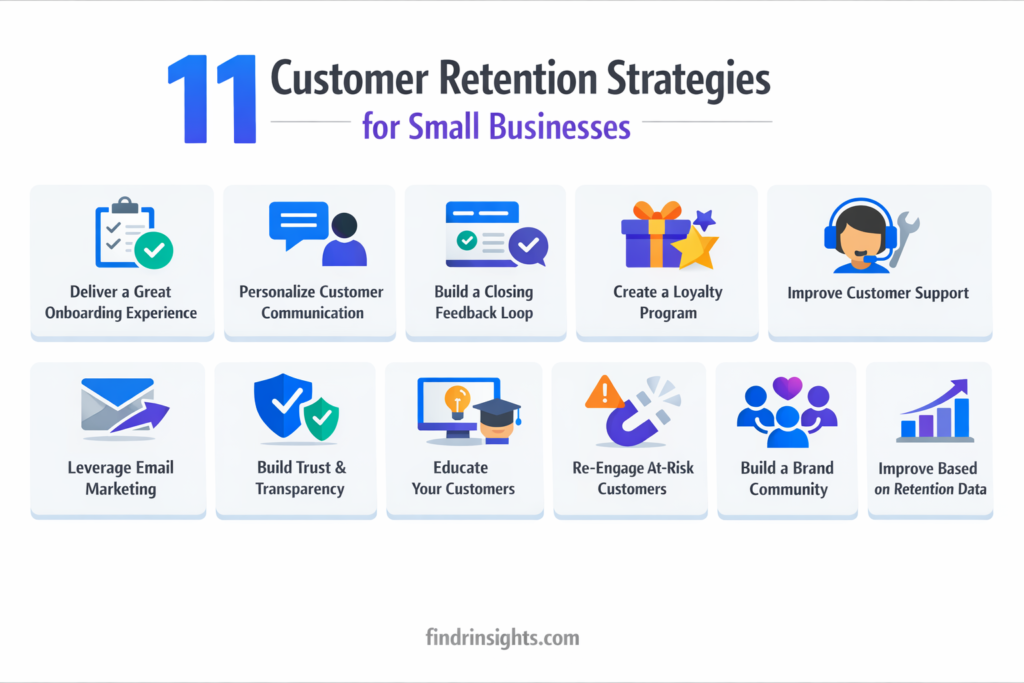
The 11 Best Customer Retention Strategies for Small Businesses
1. Deliver a Consistently Excellent Onboarding Experience
First impressions create lasting impact. When customers experience early success with your product or service, they form positive associations carrying through the entire relationship. Poor onboarding creates friction customers never forget.
Research shows 60% of software buyers regret purchases made in the last 18 months, with slow implementation and mismanaged expectations driving 24% to cancel contracts. That’s revenue walking out before you’ve delivered real value.
Small Business vs SaaS Onboarding Differences
Small businesses should focus on setting expectations and delivering quick wins. A cleaning service might send a welcome packet explaining what to expect during the first visit, followed by a check-in call after the second cleaning. The goal is to remove uncertainty and demonstrate early competence.
SaaS onboarding emphasizes time-to-value and feature discovery. Early retention improvements at one company drove week 1 retention up 15%, which cascaded into a 60% improvement by week 12. Get users to their “aha moment” fast, then gradually introduce advanced features without overwhelming them.
Customer Retention Strategy Example (Service or SaaS)
A home services company created a structured 30-day onboarding sequence.
- Day 1: Welcome email with expectations.
- Day 3: Post-first-service survey.
- Day 14: Tips for maximizing service value.
- Day 30: Introduce referral program.
This systematic approach reduced early churn by 35% by addressing concerns before they escalated into cancellations.
2. Personalize Customer Communication at Scale
Behavioral vs Demographic Personalization
Demographic personalization uses attributes like age, location, or industry. It’s better than nothing but often misses the mark. A 45-year-old suburban parent and a 45-year-old urban professional have different needs despite matching demographics.
Behavioral personalization responds to actions customers take. Someone who abandoned their cart gets different messaging than someone who just made their third purchase. With 71% of consumers expecting personalized interactions, behavioral approaches deliver the relevance people demand.
Tools Small Businesses Can Use
You don’t need enterprise software. Start with your customer relationship management system to track purchase history and preferences. Email platforms like Mailchimp or ConvertKit offer segmentation based on behavior. E-commerce platforms like Shopify provide built-in tools for tracking purchase patterns.
Customer segmentation enables you to group customers by behavior, value, or engagement level. Create segments like “high-value regulars,” “at-risk customers,” or “recent first-time buyers,” then tailor messaging accordingly.
3. Build a Customer Feedback Loop That Actually Closes
Types of Feedback That Impact Retention
Not all feedback carries equal weight. Feature requests show what customers want next. Support tickets reveal friction points. NPS scores indicate relationship health and churn risk.
Exit interviews with churned customers provide the most valuable insights. Why did they leave? What would have kept them? This helps retain future customers even when you can’t save the current relationship.
How to Act on Feedback Without Overbuilding
Closing the loop means acknowledging input, explaining decisions, and following up when relevant. Companies that close the loop on all feedback increased retention 8.5%.
Prioritize feedback from your most valuable segments. Multiple customers requesting the same improvement signals importance. One-off requests from edge cases are usually noise.
4. Create a Customer Loyalty or Rewards Program
When Loyalty Programs Work (and When They Don’t)
Loyalty programs succeed when they reward behaviors you want to encourage and provide value customers actually want. They fail when rewards feel arbitrary, redemption is complicated, or the program exists just because competitors have one.
The average consumer belongs to 16.6 loyalty programs but actively uses fewer than half. Your program needs clear value and simple mechanics to avoid becoming another ignored membership.
Cost-Controlled Loyalty Ideas for Small Businesses
Points-based systems work for businesses with repeat transactions. Every dollar spent earns points toward discounts or free products. Keep the math simple: $1 = 1 point, 100 points = $10 off. Customers should understand value immediately without calculators.
Tiered programs reward your best customers with escalating benefits. Bronze members get 5% off, silver gets 10% plus early access to sales, gold gets 15% plus free shipping. This encourages customers to increase spending to reach the next tier and unlock additional perks.
Referral programs turn customers into acquisition channels. Offer both the referrer and the new customer a benefit. “Give $20, Get $20” programs align incentives and lower your customer acquisition cost while rewarding loyalty.
5. Improve Customer Support Speed and Quality
Support as a Retention Channel
Support interactions shape perception more than marketing. A single negative experience drives 32% to competitors. Conversely, 89% with positive support become more likely to return.
Speed matters—79% expect quick responses. Delayed replies signal you don’t value their time. But speed without quality creates new problems. Resolve issues correctly on first contact.
Self-Service vs Human Support
Self-service options—knowledge bases, FAQs, chatbots—handle simple questions 24/7. Complex issues or frustrated customers need human intervention.
Combine both approaches. Self-service addresses common questions; easy escalation handles complexity. One organization implemented a help desk categorizing and routing tickets automatically, handling 500 urgent emails efficiently instead of missing vacation.
Best Customer Retention Strategies Used by High-Growth Teams
High-growth companies track first response time, resolution time, and satisfaction scores. They empower support agents to solve problems without endless approvals.
Proactive support prevents issues before contact. If your system detects problems affecting multiple customers, reach out first. This shows monitoring commitment and quality focus.
6. Use Email and Lifecycle Marketing Strategically
Lifecycle Stages That Matter for Retention
New customers need onboarding content building confidence. Active customers want product tips, feature announcements, and relevant content. At-risk customers require re-engagement campaigns.
Each stage demands different messaging. Promotional offers to brand-new customers who haven’t experienced core value waste opportunities to strengthen foundations.
Retention-Focused Email Campaign Types
Welcome series introduce your brand and set expectations. Educational content helps customers extract more value. Product updates keep relationships fresh and show continuous improvement.
Win-back campaigns target inactive customers with special offers or “we miss you” messages. Renewal reminders for subscription businesses reduce passive churn from forgotten cancellations.
7. Build Trust Through Transparency and Reliability
Operational Trust vs Brand Trust
Brand trust reflects values and positioning. Operational trust is whether you deliver on promises. Both matter, but operational trust drives retention more directly.
Consistently meeting commitments builds operational trust. If orders ship in 48 hours, hit that timeline. If you promise monthly updates, release on schedule.
How Transparency Reduces Churn
Transparency means honest communication about capabilities, limitations, and problems. Proactive communication prevents surprise. Customers appreciate knowing about server maintenance before experiencing downtime.
Pricing transparency matters especially for business model design. Hidden fees destroy trust faster than almost anything. Make costs clear upfront.
8. Educate Customers to Increase Product or Service Adoption
Education as a Retention Multiplier
Educated customers extract more value from what they’ve purchased. When customers understand all available features and best practices, they experience better outcomes, which strengthens the relationship.
One company revamped their customer success webinar program with custom landing pages, dedicated office hours with product experts, and hands-on workshops. Webinar attendance jumped 140%, and participating customers were 25% more likely to stay.
Content Formats That Drive Retention
How-to guides and video tutorials work for visual learners. Webinars allow real-time Q&A. Email courses deliver bite-sized lessons over time without overwhelming new users.
Office hours or group coaching sessions provide personalized support at scale. Certification programs create achievement milestones that increase investment in your ecosystem.
9. Proactively Re-Engage At-Risk Customers
Identifying Early Churn Signals
Behavioral changes predict churn before customers cancel. Declining login frequency, reduced purchase amounts, or longer purchase gaps all signal problems.
For service-based businesses, missed appointments or rescheduling frequency can indicate wavering commitment. Spikes in support ticket volume may indicate growing frustration.
Win-Back and Re-Activation Tactics
Automated workflows trigger when customers cross risk thresholds. A customer who hasn’t purchased in 60 days might receive a “we miss you” email with a special offer. Someone who’s reduced their subscription tier gets a check-in call to understand why.
Personalized outreach from a human, not a system, often works best for high-value accounts. A simple “I noticed you haven’t been as active lately—is everything okay?” can uncover fixable issues.
Examples of Customer Retention Strategies in SaaS
When users of a subscription service start to cancel, they’re presented with options to address their specific concern. If it’s price, they see a discounted rate for three months. If it’s lack of use, they get a pause option. If it’s missing features, they’re asked what would make them stay. This approach reduces completed cancellations by 40% by addressing objections in real-time.
10. Build Community Around Your Brand or Product
Community-Led Retention Explained
Communities create value beyond your core product. Members connect, share knowledge, and develop identity around belonging. This social dimension raises switching costs—leaving your product means leaving the community.
When customers help each other solve problems, they reduce your support burden while strengthening their expertise and investment.
Low-Cost Community Models for Small Businesses
Online forums or social media groups cost almost nothing. A Facebook group, Slack channel, or subreddit facilitates peer connection.
Regular virtual events—monthly Q&As, weekly tips, quarterly showcases—give members reasons to stay engaged. User-generated content campaigns encourage experience sharing.
11. Continuously Improve Based on Retention Data
Retention as a System, Not a Tactic
Individual tactics matter less than the system connecting them. Onboarding feeds education, which supports adoption, which generates personalization data. Each piece reinforces the others.
Companies serious about retention make it cross-functional. Product designs for engagement. Support identifies friction. Marketing creates lifecycle campaigns. Leadership allocates resources toward retention metrics.
Data Sources Small Businesses Already Have
Your CRM tracks purchase history and interactions. Email platforms show engagement rates. E-commerce platforms provide repeat purchase rates and time between orders.
Support tickets reveal common problems. Survey responses indicate satisfaction. Basic analytics—who’s buying, how often, how much—provides actionable insights.
Best Customer Retention Strategies Are Iterative
Calculate baseline retention rate. Track monthly or quarterly depending on business cycles. Measure impact when implementing initiatives.
Test one change at a time. A cleaning service might test whether follow-up calls improve retention versus automated emails.
Use learnings to refine approaches. Retention improvement compounds as you eliminate friction, strengthen relationships, and create more value.
Customer Retention Strategies by Business Type
Customer Retention Strategies for Small Business
Small businesses win through personal connection and consistent experience. You likely know customers by name. Use that advantage by remembering preferences, acknowledging milestones, and treating regulars like the valuable relationships they are.
Focus on basics first: deliver quality consistently, respond quickly to problems, show appreciation. Simple gestures—handwritten thank-you notes, birthday discounts, recognition of loyalty—create emotional connection without massive investment. Many small businesses have validated their business idea with early customers; retention means deepening those relationships.
B2B Customer Retention Strategies
B2B retention requires demonstrating ongoing business value and maintaining relationships with multiple stakeholders. You’re proving ROI to everyone who touches your solution.
Quarterly business reviews keep you aligned with customer goals and showcase results. Regular check-ins with different departments reveal changing needs before they become churn risks. Executive relationships ensure advocates during budget discussions.
Account expansion—upselling and cross-selling—shows you’re growing with customers. When your solution embeds deeper in operations, switching costs increase and retention strengthens.
SaaS and B2B SaaS Customer Retention Strategies
SaaS retention depends on product usage. If customers aren’t experiencing value, renewal rates suffer regardless of account manager friendliness.
Track activation metrics—percentage completing key first-week actions. Monitor feature adoption to identify underutilized capabilities delivering more value. Usage frequency predicts renewal likelihood more accurately than satisfaction surveys.
Integration depth matters. The more your product connects with other tools, the harder replacement becomes. API usage, data dependencies, and workflow integration increase switching costs.
Focus on reducing time-to-value. B2B SaaS customers need measurable wins to justify ongoing spend. Faster results strengthen retention position.
Summary — How to Choose the Right Retention Strategy
Matching Strategy to Business Model and Maturity
Early-stage businesses should prioritize high-impact, low-complexity strategies. Excellent onboarding, responsive support, and basic personalization deliver results without sophisticated infrastructure.
Growing businesses can add structured programs like loyalty rewards, lifecycle marketing, and community building. These require more coordination but scale retention efforts.
Mature businesses focus on data-driven optimization and advanced personalization with enough customers to segment meaningfully.
Business model shapes which strategies work best. Subscription businesses need different mechanics than transactional ones. High-touch B2B emphasizes relationships; low-touch B2C emphasizes experience and automation.
Retention Compounds Over Time
A 5% retention improvement can increase profits 25-95% because retained customers buy more frequently, spend more per transaction, and cost less to serve.
Combine quick wins with long-term investments. Start measuring retention now. Pick 2-3 strategies aligning with your model and resources. Implement systematically. Measure results. Iterate.
Retention isn’t preventing every customer from leaving. It’s creating enough value that most choose to stay, buy more, and bring others along.
Frequently Asked Questions (FAQ)
What Are Customer Retention Strategies?
Customer retention strategies are systematic methods businesses use to keep existing customers engaged and buying over time. They include onboarding programs, personalized communication, loyalty rewards, quality support, and community building. The goal is creating ongoing value that makes customers choose to continue the relationship rather than switching to competitors.
What Are the Best Customer Retention Strategies for Small Businesses?
The most effective strategies for small businesses are excellent onboarding, personalized customer communication, responsive support, and simple loyalty programs. These approaches work because they don’t require large budgets or complex technology.
Focus on consistent quality delivery, genuine appreciation for customers, and quick problem resolution. Building personal relationships remains a competitive advantage for small businesses that larger competitors struggle to replicate at scale.
How Do Customer Retention Strategies Differ in B2B vs SaaS?
B2B strategies emphasize relationship depth and demonstrated ROI. They rely on account management, executive relationships, quarterly business reviews, and proving ongoing business value. SaaS retention focuses on product adoption and usage frequency.
Success depends on onboarding effectiveness, feature discovery, integration depth, and reducing time-to-value. B2B relationships are often high-touch; SaaS relationships typically blend automation with strategic human intervention.
What Are Examples of Customer Retention Strategies That Work?
Effective examples include structured onboarding sequences that reduce early churn by 35%, behavioral email campaigns that increase repeat purchases by 28%, loyalty programs that boost purchase frequency by 40%, and proactive support that prevents 40% of cancellations before they happen.
The best examples share common elements: they’re tailored to specific customer segments, they address real friction points causing churn, and they’re measured consistently to enable continuous improvement.