The era of “spray and pray” customer acquisition is over. Customer acquisition economics in e-commerce have changed, with average losses per new customer rising from about $9 in 2013 to roughly $29 by the early 2020s—a 222% increase—driven by rising digital ad costs, higher return rates, and increased channel saturation, making broad channel proliferation an increasingly unprofitable strategy for consumer brands.
Growing your business using customer acquisition methods in 2026 requires unlearning what worked three years ago and rebuilding acquisition systems from first principles.
The underlying forces driving this shift are structural. Market saturation has made attention scarce while AI-generated content floods platforms, making differentiation harder and algorithmic volatility punishing yesterday’s winners.
Without sound unit economics, businesses that keep adding channels simply bleed cash faster. By contrast, companies building systematic acquisition approaches capture disproportionate value precisely because fragmented tactics no longer work.
Whether you operate in B2B, B2C, SaaS, or service models, the frameworks in this guide provide customer acquisition strategies that reduce acquisition costs, create compounding returns, and establish measurement systems that survive attribution collapse.
Key Takeaways:
- Customer acquisition costs have tripled, while organic reach plummeted to 36% click-through rates
- Winning strategies balance demand creation with trust acceleration across multiple channels
- Sustainable acquisition requires treating retention as an acquisition multiplier, not a separate function
- 2026 demands portfolio thinking—single-channel dependence is a vulnerability, not a strategy
What Is Customer Acquisition in 2026?
Customer acquisition is the structured process of converting market awareness into paying customer relationships through coordinated marketing and sales. In 2026, that process operates under constraints that didn’t exist in 2023.
Customer acquisition has changed dramatically. Traditional tactics now compete with AI answer engines that intercept 64% of searches before users reach websites.
Privacy-driven targeting constraints and unpredictable platform algorithms created permanent conditions, reshaping how businesses grow.
Three converging forces drive these changes:
- AI-generated content inflation has commoditized generic information. When ChatGPT can generate passable content instantly, the supply of generic information becomes effectively unlimited, eroding its market value. Value, therefore, moves upstream to proprietary data, unique perspectives, and firsthand experience—the only remaining defensible moats.
- Platform dependency risk intensified as algorithmic changes wiped out acquisition channels overnight. Companies relying on a single platform for growth have discovered that leased distribution is a liability when the landlord changes the rules.
- Buyer skepticism became the primary barrier to conversion. With AI-generated content everywhere, buyers default to distrust. Brand equity, social proof, and transparent operations became prerequisites for acquisition efficiency rather than nice-to-haves. (We’ll explore trust infrastructure in detail later.)
How Has Customer Acquisition Changed Heading Into 2026?
Understanding today’s acquisition environment requires examining three distinct shifts: structural market changes, evolving buyer psychology, and strategic gaps in mainstream acquisition advice.
Macro Trends Affecting Customer Acquisition
Privacy-first constraints fundamentally altered targeting precision. The collapse of third-party cookies forced businesses toward first-party data strategies and consent-based tracking.
In this context, first-party data encompasses information collected directly from your customers through owned channels such as website behavior, purchase history, email engagement, and explicit preferences, which requires consent but provides higher quality insights than third-party sources ever could.
As cross-device attribution grew more complex, identity resolution became essential infrastructure. Companies without robust customer data platforms now operate partially blind.
Algorithmic unpredictability turned reliable channels into volatility traps. Google’s core updates in 2024 demonstrated how overnight algorithm changes can devastate traffic. Social platforms constantly adjust their feed algorithms, making organic reach an unreliable foundation.
Performance can collapse next month despite flawless execution this quarter, meaning the variability occurs through no fault of operational excellence.
Given this reality, single-channel strategies create catastrophic vulnerability while diversification functions as essential risk management rather than an optional enhancement.
Declining marginal returns on ads plague every paid channel. Cost-per-click inflation outpaced most industries’ ability to increase customer lifetime value.
As competition intensified and ad inventory saturated, the days of scaling profitably through paid acquisition alone ended for most businesses.
Buyer Behaviour Shifts
Longer Evaluation Cycles
B2B and high-consideration B2C purchases now require extended research periods.
Buyers consume 10+ pieces of content across multiple sessions before engaging with sales, narrowing the impulse purchase window and lengthening the deliberation period.
Buyers now encounter touchpoints across days or weeks rather than following a linear awareness-consideration-purchase path.
Proof-First Decision-Making
Modern buyers demand case studies, customer testimonials, and verifiable results before committing.
The burden of proof shifted entirely to sellers, making unsubstantiated product claims ineffective since they get dismissed immediately by skeptical audiences.
Community Validation Bias
Reddit threads and niche forums carry more weight than polished marketing materials.
People append “Reddit” to searches specifically to avoid SEO-optimized content and find authentic perspectives.
Community and peer validation now influence purchase decisions more than brand messaging.
What Is the Core Customer Acquisition Framework for 2026?
Given these constraints, sustainable acquisition requires a systems approach. The following framework organizes tactics into four interdependent pillars.
While presented sequentially, these pillars operate simultaneously—trust enables capture, retention feeds creation.
The 4-Pillar Acquisition Model
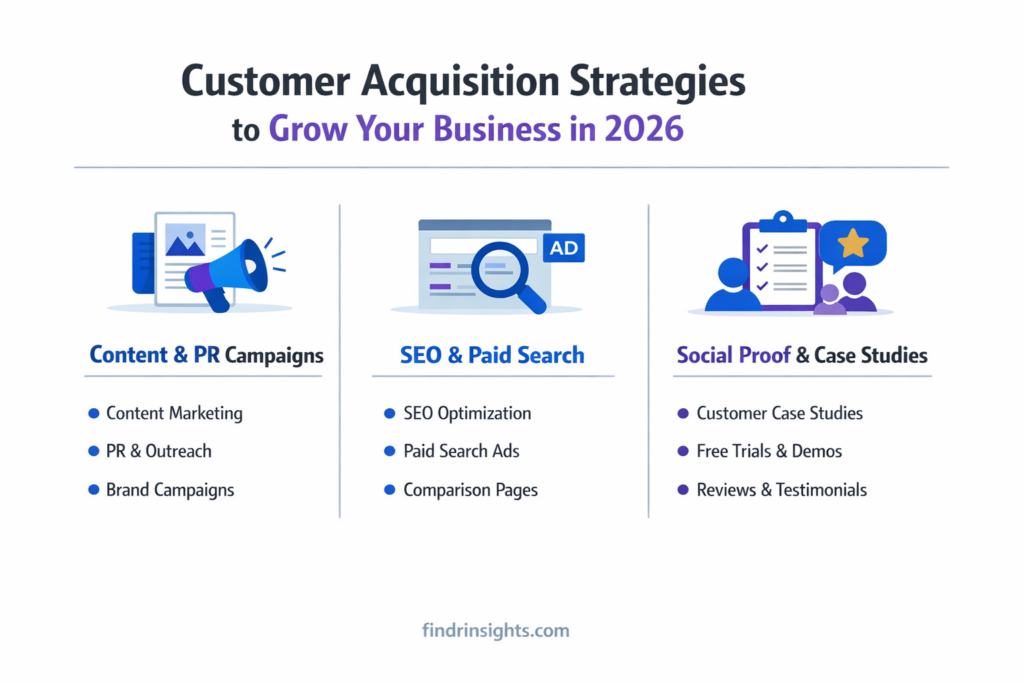
Pillar 1: Demand Creation
Demand creation generates awareness in markets that don’t actively seek solutions. Content marketing, thought leadership, and brand campaigns fall here. The goal is to make prospects aware that problems exist and that solutions are possible.
Pillar 2: Demand Capture
Demand capture converts existing search intent into customers. SEO, paid search, and conversion-optimized landing pages fall under this pillar. You’re harvesting demand that the market already expressed.
Pillar 3: Trust Acceleration
Trust acceleration shortens consideration cycles by providing proof, transparency, and risk reduction. Case studies, free trials, guarantees, and social proof compress the path from awareness to purchase.
Pillar 4: Retention-Assisted Acquisition
Retention-assisted acquisition turns existing customers into acquisition channels through referrals, reviews, and advocacy. Because satisfied customers refer new buyers at a fraction of traditional acquisition costs, retention becomes the foundation of efficient growth rather than a separate function.
| Acquisition Pillar | Primary Channels | Objective |
| Demand Creation | Content marketing, PR, brand campaigns | Build awareness in unaware markets |
| Demand Capture | SEO, paid search, comparison pages | Convert existing search intent |
| Trust Acceleration | Case studies, trials, social proof | Reduce friction and risk perception |
| Retention-Assisted | Referral programs, reviews, advocacy | Leverage customers as channels |
What Are the Most Effective Organic Customer Acquisition Strategies in 2026? (SEO-Driven)
Search-Led Demand Capture
High-intent keyword clustering organizes content around purchase intent rather than search volume. Instead of chasing broad terms, successful businesses build topic clusters covering each stage of the buyer journey.
This means creating a single pillar page supported by 20+ subtopic articles—a structure that demonstrates comprehensive expertise.
Programmatic SEO is template-based content creation at scale. It uses standardized formats to efficiently produce location pages, comparison matrices, and directory-style resources that capture long-tail searches.
The challenge lies in maintaining quality through structured differentiation: adding local insights for location pages, developing nuanced criteria for comparisons, and providing curated selections for directories prevents the commoditization that search engines penalize.
Topic authority beats keyword targeting in 2026 because search engines now evaluate comprehensive coverage across related queries as a proxy for genuine expertise, whereas isolated keyword-optimized pages signal narrow, opportunistic targeting.
Building depth across related topics signals expertise that individual pages can’t achieve.
AI-Optimized Content for Discovery
Structuring content for AI summaries and retrieval means providing clear, extractable answers.
Concise paragraphs, question-format headings, and clear definitions help search engines index your content.
As AI answer engines increasingly extract information without driving clicks, being cited becomes more valuable than ranking because citations build authority even when traffic doesn’t materialize.
Entity-based SEO focuses on establishing your brand as an authoritative entity. Consistent NAP (name, address, phone) citations, schema markup, and knowledge graph optimization signal legitimacy to search engines and AI systems.
Conversion-Oriented SEO
Content-to-offer mapping ensures every high-traffic page connects to relevant conversion opportunities.
Informational content should guide readers toward free tools, email courses, or product comparisons, because without conversion architecture leading visitors toward offers, organic traffic becomes vanity metrics that drive no business value.
Internal linking as acquisition routing guides visitors from awareness content to decision-stage resources.
Strategic anchor text and contextual relevance help both users and search engines understand your content hierarchy and conversion paths.
Summary: Organic Acquisition
Strengths: Compounding returns, lower ongoing costs than paid channels, owned distribution assets
Limits: 6-12 month ramp-up periods, vulnerability to algorithmic changes, difficulty demonstrating short-term ROI to stakeholders
Best For: Businesses that can invest in long-term authority building while supplementing with other channels for immediate traction
What Paid Customer Acquisition Strategies Work in 2026?
While organic channels compound over time, paid acquisition provides immediate traction—if economics hold.
Paid Search Reality
Branded versus non-branded economics reveal starkly different unit economics. Branded search (people searching your company name) converts at 5-10x the rate of non-branded terms while costing a fraction per click, allowing businesses to identify efficient versus wasteful investments by monitoring performance across these distinct categories. Businesses often discover they’re profitable on brand terms but lose money on everything else.
Automation tradeoffs characterize modern paid search platforms. Smart bidding and automated campaigns reduce optimization time but sacrifice bid-level control.
Performance Max campaigns on Google distribute budgets across channels algorithmically—effective when they work, opaque when they don’t.
Paid Social Evolution
Ad creative quality now matters more than targeting precision. Privacy restrictions limited targeting capabilities, forcing platforms to rely on creative quality as an engagement signal and shifting competitive advantage toward brands that test extensively.
As a result of this structural change, brands testing 20+ creative variations monthly outperform those running static campaigns because creative has become the primary differentiation factor.
Platform volatility considerations require hedging across multiple networks. TikTok, Meta, LinkedIn, and YouTube each serve different audiences with different behavior and intent levels. Over-concentration on any single platform creates fragility.
| Channel | Cost Curve | Scalability |
| Paid Search – Branded | Stable, low CPC | Limited by brand awareness |
| Paid Search – Non-branded | Rising CPCs, high competition | High but often unprofitable |
| Paid Social – Meta | High CPCs, creative-dependent | Moderate, requires constant testing |
| Paid Social – LinkedIn | Premium CPCs, B2B focus | Limited audience, high value |
| Display/Programmatic | Low CPCs, low conversion | High volume, poor quality |
Summary: Paid Acquisition
Strengths: Immediate results, predictable testing cycles, granular budget control
Limits: Continuous costs, creative fatigue, diminishing returns at scale, vulnerable to platform policy changes
Best For: Businesses needing immediate traction while building organic assets, high-LTV products that can absorb rising CPCs
How Does Content-Led Customer Acquisition Work?
Authority Content vs Commodity Content
Differentiation starts with founder perspective. When anyone can generate generic advice, firsthand experience building businesses becomes valuable. Vulnerability, specific tactical details, and contrarian takes cut through noise.
Building on this foundation, original research transforms personal insight into industry authority by publishing proprietary surveys, conducting industry analysis, or sharing unique datasets.
These research assets create references that other creators link to, generating passive distribution that compounds over time.
Distribution-First Content Strategy
Owned distribution assets—email lists, communities, and proprietary platforms—provide algorithmic independence. Building direct audience relationships protects against platform volatility.
A 50,000-subscriber email list outvalues 500,000 social followers, subject to feed algorithm,s because owned channels guarantee reach, while rented audiences face unpredictable visibility, making direct relationships the only durable distribution strategy.
Formats That Drive Acquisition
Acquisition-driving formats operate across a trust spectrum. At the awareness end, long-form guides demonstrate expertise through comprehensive coverage.
The 5,000-word definitive resource attracts links, ranks broadly, and converts better than shallow listicles because depth signals authority.
Mid-funnel, interactive tools such as calculators, assessments, and configurators provide immediate value while capturing leads. ROI calculators and comparison tools simultaneously generate qualified traffic and conversions.
At decision stage, case studies and teardowns showcase real results with transparent methodology. Specific numbers, named clients (with permission), and before/after comparisons build trust faster than abstract claims.
Summary: Content-Led Acquisition
Strengths: Authority building, multiple distribution channels, content assets appreciate over time, supports other acquisition channels
Limits: Requires consistent production, results take 3-6 months to materialize, difficult to attribute directly, demands genuine expertise
Best For: Businesses with subject matter expertise, companies targeting educated buyers, brands building long-term market position
What Is Product-Led and Experience-Led Acquisition?
Beyond content and paid channels, the product itself can drive acquisition—particularly for software and digital services.
Product as the Acquisition Channel
Product-led growth (PLG) is a go-to-market strategy where the product itself drives acquisition, conversion, and expansion.
Users can access and experience core value without sales involvement, allowing the product to demonstrate its worth directly. Freemium models, free trials, and self-serve onboarding are common PLG approaches.
Freemium and trials remove friction by letting prospects experience value before paying.
Product-led growth strategies achieve 2x faster revenue growth than sales-led approaches by making the product itself the primary acquisition vehicle, allowing direct experience with solutions to convert prospects more effectively than any sales pitch can.
Interactive demos provide hands-on exploration without commitment. Self-serve onboarding that delivers value in minutes dramatically increases conversion rates compared to gated demos that require sales calls.
Experience Differentiation
When product experiences are designed for viral invitation, onboarding becomes an acquisition channel.
Slack demonstrated this by making team invitations happen naturally during product use, creating a distribution model where the product spreads through normal usage patterns rather than requiring dedicated marketing campaigns.
The first-time user experience optimized for delight and quick wins turns adoption into advocacy.
UX-driven referrals emerge when products are genuinely enjoyable to use and easy to share.
Dropbox’s referral bonus for extra storage aligned user incentives with acquisition goals—both parties benefited from invitations, creating a self-reinforcing growth loop.
| Metric | Product-Led Growth | Sales-Led Growth |
| Average CAC | $100-300 | $500-1,500 |
| Sales Cycle | Days to weeks | Weeks to months |
| Initial Deal Size | Lower | Higher |
| Expansion Rate | 120-150% net retention | 90-110% net retention |
| Scalability | High (self-serve) | Limited (headcount) |
Summary: Product-Led Acquisition
Strengths: Lower CAC, faster sales cycles, scalable without headcount growth, product improvements directly impact acquisition
Limits: Requires product excellence, works best for simple use cases, may yield lower initial contract values, demands investment in self-serve infrastructure
Best For: SaaS products, digital tools, collaborative software, businesses with straightforward value propositions
How Do Partnerships Drive Customer Acquisition?
Partnerships operate on a spectrum from transactional to structural, with each tier requiring different resources but offering increasing sustainability.
Strategic Partnerships
Co-marketing arrangements split acquisition costs while enabling access to new audiences—webinar partnerships, co-authored content, and joint campaigns reach prospects neither party could efficiently target on its own.
Co-distribution agreements embed your product in partner workflows through API integrations, app marketplace listings, and technology partnerships.
These create acquisition channels that require minimal ongoing investment once established.
Platform integrations expose solutions to users actively seeking tools. Slack’s app directory, Shopify’s app store, and Zapier’s integration catalog function as acquisition channels—prospects discover you while solving adjacent problems.
Community and Network Effects
Creator ecosystems turn influencers and micro-influencers into acquisition channels. Through affiliate programs, ambassador networks, and creator partnerships, businesses leverage trusted voices in niche communities to generate credibility that traditional advertising cannot replicate.
Niche authority leverage means going deep in specific communities rather than broad across demographics. Becoming the recognized solution in specialized forums, subreddits, or professional associations generates high-intent, qualified leads.
Partnerships outperform ads in saturated markets by providing credibility that ads can’t buy. A recommendation from a trusted industry figure converts better than any paid placement because borrowed credibility shortens consideration cycles when buyer skepticism is high.
Summary: Partnership Acquisition
Strengths: Borrowed credibility, shared costs, access to established audiences, often higher conversion rates than cold outreach
Limits: Requires relationship building, partner alignment challenges, less direct control, results depend on partner execution
Best For: Businesses with complementary (not competing) partners, companies targeting established communities, products that integrate into existing workflows
How Do Trust, Proof, and Brand Function as Acquisition Multipliers?
Acquisition fails without a trust infrastructure regardless of channel sophistication. Businesses that invest in social proof, authority-building, and transparent operations see acquisition efficiency improve across all channels. Rather than functioning as a separate initiative, trust serves as the foundational layer enabling everything else to work.
Trust Signals That Convert in 2026
Trust signals form layers of verification that work together to overcome buyer skepticism.
Foundation layer: Social Proof
Social proof provides peer validation through reviews, testimonials, case studies, and user counts.
Displaying specific results from named customers (with permission) outperforms anonymous aggregated claims because granular proof beats generic assertions.
Credibility layer: Authority Indicators
Authority indicators establish institutional legitimacy through professional credentials (certifications and awards) and third-party validation (media mentions and expert endorsements).
Being featured in recognized publications or holding relevant certifications signals competence before prospects investigate deeply.
Authenticity layer: Transparency Assets
Transparency assets such as public roadmaps, transparent pricing, and behind-the-scenes content demonstrate confidence through visibility.
Companies that share challenges alongside successes appear more credible than those that project perfection.
Each layer reinforces the others. When combined, these verification types make each individual element more believable, creating a trust infrastructure that reduces friction across all acquisition channels.
Brand as a CAC Reduction Mechanism
Brand search demand lowers acquisition costs by capturing prospects already familiar with your solution. Strong brands enjoy lower CPCs on branded search terms and higher organic CTRs because recognition reduces the persuasion burden.
Conversion rate amplification occurs when brand familiarity shortens the consideration period.
Known brands convert 2-3x better than unknown competitors because trust already exists. The same traffic generates more revenue when prospects arrive with pre-existing positive associations.
Summary: Trust-Based Acquisition
Strengths: Reduces CAC across all channels, improves conversion rates, creates pricing power, compounds over time
Limits: Takes 12-24 months to build meaningful brand equity, difficult to measure directly, requires consistent investment
Best For: Businesses planning multi-year market presence, companies in crowded markets where differentiation is critical, brands targeting buyers with high consideration periods
How Does Customer Retention Drive Acquisition?
Retention-Driven Growth Loops
Satisfied customers generate referrals, which bring in new customers who create reviews, which accelerate future conversions—the cycle repeats with expanding social proof. This creates three distinct acquisition benefits:
- Referrals: Cost 5x less than traditional acquisition and convert at higher rates because trusted recommendations overcome initial skepticism
- Reviews and ratings: Influence purchase decisions more than marketing claims by providing independent validation
- User-generated content: Provides dual benefits of authentic social proof and SEO-friendly content as customers share experiences and use cases
Lifetime Value Expansion
Retention directly impacts acquisition sustainability through payback dynamics. If CAC is $300 and monthly revenue per customer is $50, you need six months to break even.
Any customer who churns before month six represents a net loss on acquisition investment, turning what seemed like a customer win into an economic failure.
Strong retention allows higher acquisition investments by extending the window to recoup costs and generate profit.
How Do You Measure and Optimize Customer Acquisition Performance?
Acquisition metrics form a hierarchy. Foundation metrics (CAC, LTV) establish unit economics.
Diagnostic metrics (payback, channel efficiency) identify optimization opportunities. Attribution provides directional guidance despite technical limitations.
Metrics That Matter in 2026
CAC (customer acquisition cost) is the total sales and marketing spend divided by the number of new customers acquired: (Total Marketing Spend + Sales Expenses) / New Customers.
Breaking this calculation down by individual channel reveals which investments drive efficient growth versus which burn budget without proportional returns.
LTV (lifetime value) measures total customer revenue over their lifespan. Calculate this by multiplying average purchase value, frequency, and retention period.
For sustainable growth, the LTV:CAC ratio should exceed 3:1 to ensure that customer value significantly outweighs acquisition investment.
Payback period measures time required to recover acquisition costs: CAC / Average Monthly Revenue per Customer. Shorter payback periods improve cash flow and reduce capital requirements for growth.
Channel efficiency compares performance across acquisition sources. Evaluate each channel’s CAC, conversion rate, customer quality, and scalability potential rather than relying on last-click attribution.
Attribution Reality
Multi-touch complexity reflects the messy truth that customers interact with multiple touchpoints before converting.
Attributing conversions to single channels oversimplifies buyer journeys and leads to misallocated budgets.
AI attribution limits emerged as privacy restrictions and cross-device fragmentation made precise tracking impossible.
Marketing mix modeling and incrementality testing provide directional guidance when perfect attribution isn’t feasible.
| Metric | Calculation | Benchmark |
| CAC | (Marketing + Sales Costs) / New Customers | Varies by industry ($50-$1,500) |
| LTV | Avg Purchase × Frequency × Lifespan | 3x+ CAC |
| LTV:CAC Ratio | LTV / CAC | 3:1 to 4:1 |
| Payback Period | CAC / Monthly Revenue per Customer | <12 months |
| Channel CAC | Channel Spend / Channel Customers | Compare across channels |
What Customer Acquisition Mistakes Should Businesses Avoid in 2026?
Tactical Errors
Single-channel dependence creates catastrophic vulnerability. Businesses that derive 80%+ of revenue from a single platform become fragile when algorithms change or costs spike.
As discussed in Macro Trends, algorithmic unpredictability makes diversification essential risk management.
Tool-first thinking prioritizes software over strategy. Buying marketing automation platforms before understanding conversion paths or implementing attribution systems before clarifying goals wastes resources.
Because tools only amplify existing strategies rather than creating them, defining clear strategies before selecting software helps prevent costly misalignment.
Strategic Errors
Underinvesting in brand building leads to perpetual CAC inflation. Companies that treat their brand as optional fight commodity-pricing battles forever. Building brand equity reduces acquisition costs over time by creating preference before prospects enter active consideration.
Underinvesting in owned assets means renting distribution instead of building equity. Email lists, communities, and organic rankings compound value over time. Without owned channels generating persistent value, businesses depend entirely on platforms where distribution stops the moment spending stops.
How Do You Build a Sustainable Customer Acquisition System?
Acquisition as a System
Portfolio-based channel thinking balances risk across multiple acquisition sources and creates compounding leverage when channels reinforce one another. Allocate budgets to develop resilience: paid channels for immediate results, SEO for compounding returns, partnerships for credibility, and product-led growth for scalability.
This integration makes the system more valuable than isolated tactics. Content supports SEO and email growth while paid ads drive traffic that builds retargeting audiences.
Product users become case studies that enable sales. Rather than operating in isolation, channels working in concert create efficiency advantages impossible through any single approach.
| Strategy Type | Primary Investment | Time to Results | Sustainability | Best For |
| Organic (SEO) | Content + links | 6-12 months | High | Long-term authority builders |
| Paid (Ads) | Media spend | Immediate | Low (stops when spend stops) | Immediate traction needs |
| Partnership | Relationship building | 3-6 months | Medium-High | Established market players |
| Product-Led | Product development | 1-3 months | High | SaaS and digital products |
| Content-Led | Production + distribution | 3-6 months | High | Expert-driven businesses |
12-24 Month Acquisition Roadmap
Short-term traction (0-6 months) comes from paid channels, partnerships, and quick-win SEO opportunities. Launch campaigns, establish measurement infrastructure, and validate channel fit.
Long-term defensibility (6-24 months) requires investing in SEO, brand building, community development, and owned distribution. These channels compound but need patience. Businesses balancing immediate results with future assets outperform those optimizing purely for short-term returns.
Channel Strategy by Business Model
Different business models require different acquisition approaches. This matrix helps prioritize based on your context.
| Business Model | Primary Channels | Secondary Channels | Avoid |
| B2B SaaS | Product-led growth, SEO, LinkedIn | Content marketing, partnerships | Mass display ads, generic social |
| B2C E-commerce | Paid social, influencer partnerships | Email, SEO | Long sales cycles, enterprise tactics |
| Local Services | Local SEO, referrals, Google Business Profile | Community engagement, partnerships | National paid campaigns, broad targeting |
| Consulting/Agency | Content authority, LinkedIn, referrals | SEO, speaking/PR | Paid ads (usually unprofitable) |
| Marketplace/Platform | Product virality, SEO, partnerships | Content, community | Heavy paid dependency early |
Frequently Asked Questions About Customer Acquisition in 2026
What is the most effective customer acquisition strategy in 2026?
Effectiveness depends on context—specifically, business model, market maturity, and resources. For instance, B2B SaaS companies often find product-led growth most efficient, while local service businesses succeed with SEO and referrals. E-commerce brands typically require paid ads supplemented by email and content. The best approach combines 2-3 channels aligned with your customer’s buying journey rather than chasing the latest trend.
Is paid advertising still viable for customer acquisition?
Paid advertising remains viable but requires sophistication. Blindly scaling ad spend leads to unprofitability as costs rise and returns diminish.
Successful paid strategies in 2026 involve rigorous creative testing, granular audience segmentation, and integration with organic channels.
Use paid ads for immediate traction while building compounding organic assets. Monitor unit economics closely—profitability varies dramatically between branded and non-branded campaigns.
How long does it take to see results from organic acquisition?
SEO and content-driven acquisition typically require 6-12 months before generating meaningful volume. Early months focus on building authority, earning links, and establishing topical coverage.
Momentum accelerates as domain authority grows and content begins ranking. Businesses needing immediate results should combine organic efforts with paid channels rather than expecting fast SEO wins.
How should small businesses approach customer acquisition differently?
Small businesses benefit from concentrated focus on fewer channels executed exceptionally well. Instead of spreading thin across every platform, choose 1-2 channels aligned with where customers naturally discover solutions.
Local businesses often win with Google Business Profile optimization, local SEO, and referral programs. Service businesses succeed with niche content and strategic partnerships.
Avoid enterprise tactics requiring large budgets—compete on depth and personal engagement instead.
How does AI impact customer acquisition strategies?
AI affects acquisition in three ways:
- AI-generated content floods search results, making original expertise more valuable
- AI answer engines change search behavior—optimize for being cited rather than clicked
- AI tools enable smaller teams to compete through automated personalization, creative testing, and data analysis
Embrace AI for efficiency while doubling down on human elements: original insights, authentic experiences, and genuine relationships that AI can’t replicate.
Final Summary — Winning Customer Acquisition in 2026
What to prioritize:
- Build trust infrastructure before scaling channels—social proof, authority signals, and transparency assets improve efficiency across all acquisition efforts
- Invest in owned distribution assets that compound over time rather than relying exclusively on rented platforms
- Develop portfolio-based channel strategies rather than single-source dependencies
- Measure true channel-level profitability using LTV:CAC ratios and payback periods
What to stop relying on:
- Single-channel strategies that create platform dependency and algorithmic risk
- Purely performance marketing without brand investment, which leads to perpetual CAC inflation
- Volume metrics without conversion architecture, where traffic means nothing without systematic paths to purchase
- Perfect attribution, since privacy restrictions made precise tracking impossible; focus on directional guidance instead
What to build for long-term advantage:
- Proprietary data and original insights as content moats that AI can’t commoditize
- Systematic referral and advocacy programs that turn customers into acquisition channels
- First-party data collection and identity resolution capabilities as targeting precision declines
- Diversified acquisition systems resilient to platform changes and market shifts
Customer acquisition in 2026 rewards strategic thinking over tactical execution.
The businesses thriving aren’t those with the most significant budgets, but those treating acquisition as an integrated system rather than a collection of campaigns.
Start by validating your business idea, choosing channels that align with your customers’ journey, and building compounding assets while running performance campaigns.
The sustainable path forward combines immediate results with long-term value creation.