If you’re running a business, hiring and recruiting are not the same process, and understanding that difference will save you time, money, and headaches.
Most business owners post a job, review resumes, conduct interviews, and make an offer.
That approach seems efficient, but it leads to roles that take months to fill, candidates who ghost you after accepting offers, and new hires who quit within 90 days.
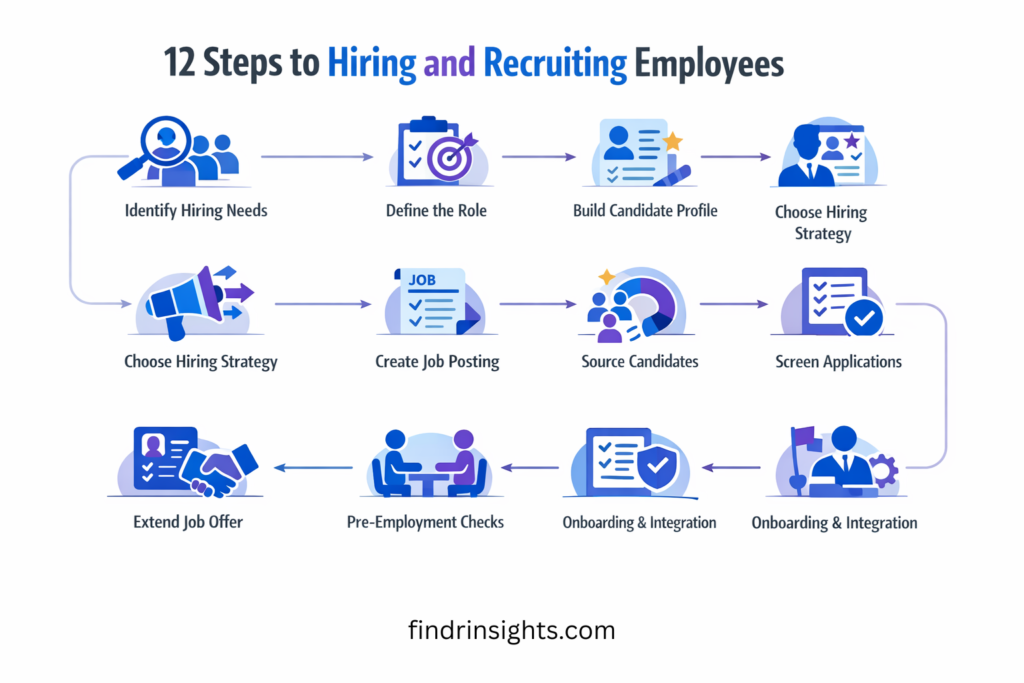
This guide walks you through the complete 12-step hiring and recruiting process that businesses use to build strong teams. You’ll learn what each process does, who handles what, and how to execute every step without wasting resources.
Key Takeaways:
- Recruiting builds your talent pipeline proactively; hiring selects specific individuals reactively to fill immediate vacancies
- 45% of employers struggle to find qualified candidates, making structured processes essential for success
- Only 15% of business leaders feel fully confident in their hiring decisions at the time of hire
- The average time-to-fill is 38-42 days for most positions
What Is Hiring and Recruiting? Core Definitions Explained
What Is Recruiting?
Recruiting is the proactive process of building relationships with potential candidates and creating a talent pipeline before you need them.
Think of recruiting as attracting people before vacancies exist. You’re building your employer brand. You’re maintaining relationships with qualified professionals who could join your team when the timing’s right.
Recruiting focuses on passive candidates (people employed elsewhere who aren’t job hunting) and active candidates (people currently searching). The goal is to have a pool of interested, qualified people ready when positions open.
What Is Hiring?
Hiring is the reactive process of selecting and onboarding a specific person for an immediate vacancy. Once recruiting delivers candidates, hiring takes over.
Hiring includes screening applications, conducting interviews, evaluating candidates, extending offers, and completing paperwork—a process that narrows the scope from many potential candidates to one selected hire. While recruiting casts a wide net, hiring filters that pool down to your best match.
Are Hiring and Recruiting the Same?
No—recruiting fills your talent pool, while hiring singles out individuals from that pool.
Recruiting is strategic and ongoing. Hiring, on the other hand, is transactional and happens when you have an opening. Recruiting builds relationships over months or years, while hiring makes decisions over weeks.
Here’s a practical example: A bakery owner maintains relationships with culinary school graduates and attends local food festivals to meet potential bakers.
That’s recruiting. When the head baker quits, the owner calls three people from that network, interviews them, and selects one. That’s hiring.
Difference Between Hiring and Recruiting
Strategic vs Operational Focus
Recruiting operates strategically with a long-term view. You’re thinking about future needs, building your employer brand, and maintaining talent relationships. Hiring operates tactically with immediate needs. You have an open role today that must be filled within weeks.
Time Horizon and Responsibilities
Recruiting never stops. You’re always sourcing candidates, even when fully staffed. Hiring starts when a position opens and ends when someone accepts your offer.
Recruiting responsibilities include employer branding, talent sourcing, relationship building, and pipeline development.
Hiring responsibilities include application screening, interview coordination, candidate evaluation, offer negotiation, and onboarding execution.
| Aspect | Recruiting | Hiring |
| Focus | Building talent pipeline | Filling specific vacancy |
| Timeline | Ongoing, proactive | Immediate, reactive |
| Candidate Type | Passive and active seekers | Active applicants |
| Scope | Wide talent pool | Narrow selection |
| Goal | Relationships for future needs | Decision for current opening |
Which Department Is Responsible for Hiring and Recruiting of Workers?
HR Department Responsibilities
In companies large enough to have HR departments, human resources owns the recruiting and hiring process. HR writes job descriptions, posts openings, screens initial applications, and manages compliance with employment laws.
HR professionals handle the administrative aspects: tracking applicants, scheduling interviews, conducting background checks, processing offer letters, and managing onboarding paperwork. They ensure consistency across hiring decisions and maintain legal compliance throughout the process.
Hiring Managers’ Role
The hiring manager is the department head or supervisor who originally requested the new position. They define what skills and experience the role requires. They make the final hiring decision based on team needs.
While HR manages the process logistics, hiring managers drive the content substance. They determine whether candidates have the technical skills for the job.
They assess cultural fit within their specific team. They typically conduct the final interviews and extend verbal offers.
Recruiting Teams and External Recruiters
Larger companies employ dedicated recruiters who focus exclusively on sourcing candidates. These recruiters don’t make hiring decisions but specialize in finding qualified people for hiring managers to evaluate.
External recruiters (agencies) work on either a retained or contingency basis. Retained recruiters receive an upfront fee and work exclusively on your search.
Contingency recruiters only get paid when you hire their candidate, often charging 15-25% of the first-year salary.
How Responsibility Shifts in Small vs Large Businesses
In small businesses and home-based businesses, the owner handles everything. You’re the recruiter, HR department, and hiring manager rolled into one person.
As you grow to 10-25 employees, you might hire an office manager who wears the HR hat. At 25-50 employees, you’ll likely need a dedicated HR generalist. Beyond 50 employees, you can justify specialized recruiting roles.
If you’re growing to the point of hiring dedicated recruiting staff, see the section below on recruiting roles and budget ranges to expect.
The Complete 12-Step Hiring and Recruiting Process
The hiring and recruiting process takes an average of 38-42 days from identifying the need to getting someone productive in the role. Here’s how to execute each step without wasting time or money.
Step 1 – Identify Hiring Needs and Workforce Gaps
Start by determining whether you need a new hire. Business owners who hire before validating six months of payroll sustainability often face cash flow crises.
Ask yourself: Is this workload temporary or permanent? Can technology solve this problem? What revenue increase would this hire generate?
Align hiring decisions with your business plan and growth trajectory. If you’re building a scalable business, workforce planning becomes strategic, not reactive.
Budget Planning Throughout the Process: Hiring costs include job board fees ($200-$1,500), background checks ($30-$200), agency fees if applicable (15-25% of first-year salary), and the average cost per hire of $4,700, all of which should be factored into your operating budget before starting the process.
Checklist: Current capacity vs projected demand, skills gaps limiting growth, revenue-generating vs support roles, budget availability for six months minimum
Time Investment: 3-5 hours
Step 2 – Define the Role and Success Criteria
Write down exactly what this person will do and what success looks like in their first quarter.
Most job descriptions list requirements but miss outcomes. Define what this person must accomplish and which KPIs will measure success.
Be specific about what matters. If you’re hiring for a service-based business, customer retention matters. For consulting, billable hours and client satisfaction matter more.
Success Timeline:
- Month 1: Complete core job functions with manager guidance and regular feedback
- Month 2: Perform core responsibilities independently with occasional clarifying questions
- Month 3: Contribute meaningfully and demonstrate full role competency
Must-Haves vs Nice-to-Haves: Non-negotiable skills required for basic performance vs bonus qualifications vs deal-breaker characteristics
Time Investment: 2-4 hours
Step 3 – Build the Ideal Candidate Profile
Beyond the behavioral traits and soft skills that predict performance, your profile should also specify required technical capabilities.
Consider diversity factors—companies with diverse teams see 19% higher innovation revenue. Focus on skills rather than credentials since relevant experience often outperforms degrees.
Time Investment: 1-2 hours
Step 4 – Choose Hiring and Recruiting Strategies
Based on your candidate profile from Step 3, select recruitment channels where those candidates gather.
Decide whether to recruit internally, externally, or both.
Internal recruiting promotes current employees, offering faster timelines, lower costs, and morale benefits—but simply moves the vacancy elsewhere.
External recruiting brings fresh perspectives and new skills through job boards, social media, employee referrals, recruiting agencies, job fairs, and your professional network.
Current data shows 75% of organizations struggle to fill roles, making your strategy choice critical. Employee referrals generate about 30% of applicants and result in hires who are significantly more likely to succeed than candidates from other sources.
Platform Options:
- Free job boards: Indeed (limited features), LinkedIn (organic posts), Craigslist for local positions
- Paid job boards: Indeed Sponsored (pay-per-application), LinkedIn Premium (InMail credits), ZipRecruiter (multi-board distribution), industry-specific boards (higher quality matches)
- Applicant tracking systems: Centralize applications and automate candidate communication workflows (see Tools section for details)
- Recruiting agencies: Best investment for specialized positions or senior leadership roles requiring deep industry expertise
Time Investment: 1-2 hours to select channels and set up accounts
Cost Range: $200-$1,500+ depending on platforms and sponsorship levels
Step 5 – Create and Publish the Job Posting
Write a job posting that attracts qualified candidates without drowning in unqualified applications.
Your opening should sell the opportunity, not just list requirements. Instead of “XYZ Company seeks an experienced marketing manager,” try “Help us triple our customer base while building marketing systems from scratch.”
Your posting structure should include these sections: role overview (2-3 sentences about what they’ll do), key responsibilities (5-7 bullet points), required qualifications (3-5 must-haves), preferred qualifications (2-3 nice-to-haves), compensation range (required in many states), and benefits highlights.
Naturally incorporate keywords throughout: “This hiring and recruiting process typically takes 3-4 weeks from application to start date.”
SEO-Friendly Structure:
- Title includes both job title and key skill (e.g., “Senior Accountant – QuickBooks Expert”)
- Location specified clearly for local candidates
- Salary range mentioned to improve click-through rates
- Mobile-friendly formatting uses short paragraphs for easy scanning
Time Investment: 2-3 hours to write, review, and post
Step 6 – Source and Attract Candidates
With your posting live, actively recruit candidates rather than waiting passively for applications. This step separates businesses that fill roles quickly from those that struggle for months.
Follow this sequence:
- Post your job description on selected platforms
- Set up tracking system (even a spreadsheet works initially)
- Activate network outreach through LinkedIn connections and employee referrals
- Schedule daily candidate review and response protocol
Beyond job boards, tap into your network. Message relevant LinkedIn connections. Ask current employees for referrals with $500-$1,000 bonuses to incentivize participation.
Attend industry events where potential candidates gather. Build your employer brand by sharing company culture content on social media.
Respond to every application within 48 hours, even if it’s just “We received your application and will review it within one week.” Use email templates for common communications to maintain efficiency.
Some businesses use specialized frontline hiring and recruiting platforms that streamline high-volume hiring for retail, hospitality, and service industries.
These platforms typically include mobile-friendly applications, automated scheduling, and bulk communication tools (see the Tools section for platform details).
Time Investment: 2-4 weeks of active sourcing
Response Rate: You should expect 20-50 applications for entry-level roles and 5-15 for specialized positions.
Step 7 – Screen Applications and Resumes
Separate qualified candidates from the rest without spending hours on each resume.
Create a scoring rubric based on your must-haves from Step 2, then spend 2-3 minutes scoring each resume against these criteria. Advance anyone scoring above your threshold to phone screens.
Look for accomplishments, not duties. “Increased sales 47%” beats “Responsible for sales.” Watch for employment gaps or frequent job changes, but evaluate pattern context rather than disqualifying candidates automatically.
Time Investment: 5-10 minutes per resume
Target: 5-10 candidates for phone screens
Step 8 – Conduct Interviews and Assessments
Given that 60% of business leaders doubt hiring decisions, structured interviews reduce uncertainty through objective comparison. Your interview process should gather comparable information from everyone.
Start with phone screens (15-20 minutes) to verify basic qualifications and interest. Ask about salary expectations, availability, and key requirements. This eliminates mismatches before investing time in full interviews.
For candidates who pass the phone screen, schedule formal interviews. Use behavioral questions that reveal past performance—such as “Tell me about a time when you had to meet a tight deadline with limited resources”—because past behavior predicts future performance better than hypothetical questions.
If you’re hiring a designer, ask for portfolio work; for a customer service role, conduct a role-play scenario—whatever assessment you use must be relevant to actual job duties.
Interview Format Options:
- Panel interviews: Multiple interviewers at once (efficient but can overwhelm candidates)
- Sequential interviews: Candidate meets different people separately (time-intensive but thorough)
- Working interviews: Candidate performs job tasks (best predictor but requires compensation)
Time Investment: 1-2 hours per candidate for initial interviews, 2-4 hours for final round
Step 9 – Evaluate Candidates and Make Decisions
You’ve interviewed 3-5 strong candidates—choose the best fit using standardized criteria rather than gut feeling.
Evaluation Process:
Use standardized evaluation forms where each interviewer rates candidates on specific criteria. Compare scores across your team before deciding.
Reference checks matter. Call at least two previous supervisors with specific questions about performance and reliability.
What to Watch For:
Unconscious bias affects decisions. Diverse teams perform better, but hiring managers often favor candidates who remind them of themselves. Focus on demonstrated skills and objective criteria.
Time Investment: 2-4 hours
Step 10 – Extend the Job Offer
You’ve made your choice. Now present an offer that gets accepted while maintaining budget sustainability.
Your offer letter should include job title, start date, salary, benefits overview, work schedule, employment type (full-time, part-time, exempt, non-exempt), reporting structure, and any contingencies (background check, drug test).
Be prepared to negotiate by knowing your salary range beforehand and having approval to move within that range or offer additional benefits. Research shows 48% of candidates reject offers due to non-competitive salaries, and 76% prioritize non-monetary benefits.
Make the offer by phone first, then follow up with a written letter—the personal touch increases acceptance rates. Be enthusiastic but not desperate.
Consider how this salary fits within your startup costs and six-month operating budget committed in Step 1.
Offer Components:
- Base compensation (salary or hourly rate)
- Bonus or commission structure (if applicable)
- Benefits (health insurance, retirement, PTO)
- Perks (remote work, flexible schedule, professional development)
- Start date and onboarding timeline
Time Investment: 1-2 hours to prepare and present offer
Acceptance Timeline: Give candidates 3-7 days to consider (1-2 days for urgent roles)
Step 11 – Complete Pre-Employment Checks
After offer acceptance but before Day 1, verify credentials and work eligibility.
Complete Form I-9 within three days of the start date to verify employment eligibility as federally required.
Run background checks if relevant—financial positions need credit checks, driving roles need motor vehicle records, and roles with vulnerable populations require criminal screening, all following FCRA requirements.
Verify education credentials for roles requiring specific degrees. Confirm professional licenses for regulated professions.
Just as legal requirements vary when starting a business, hiring has its own compliance framework by state and industry.
Time Investment: 1-2 hours to initiate checks
Processing Time: 3-10 business days
Cost Range: $30-$200 depending on depth
Step 12 – Onboarding and First-90-Day Integration
Your new hire accepted the offer and passed background checks. Now set them up for success through structured onboarding that reduces the 20% turnover rate in the first 45 days.
Pre-boarding (before Day 1): Send welcome email with start date, time, location, parking information, dress code, and what to bring. Mail or email forms they can complete before arriving (W-4, direct deposit, benefits enrollment). Ship equipment if they’re remote.
Day 1: Focus on welcome and orientation. Introduce them to the team. Set up their workspace. Review company policies and expectations. Assign an onboarding buddy who can answer questions informally.
Week 1: Provide role-specific training. Schedule daily check-ins with their manager. Ensure they have necessary access (software, keys, passwords). Set clear goals for their first 30 days.
First 90 Days: Schedule weekly one-on-ones. Provide feedback regularly, not just at formal reviews. Check in at 30, 60, and 90 days to assess progress and address concerns.
Performance Ramp-Up Checklist:
- Week 1: Complete orientation, basic training, and essential system access setup
- Month 1: Execute core job functions with manager guidance and regular feedback loops
- Month 2: Perform independently with occasional clarifying questions and minimal supervision required
- Month 3: Contribute meaningfully, identify improvement opportunities, and demonstrate full role competency
Time Investment: 20-40 hours of manager and team time spread over 90 days
With the 12-step process established, here’s how to optimize execution through proven strategies and common pitfall avoidance.
Hiring and Recruiting Tips for Business Owners
Practical Hiring and Recruiting Tips That Reduce Risk
Priority 1: Speed
Move faster on top candidates. The best people receive offers within 10 days of starting their search, so delays cost you talent.
Build talent pipelines before you need them. Maintain relationships with strong candidates you couldn’t hire. When a role opens, you already have warm leads.
Priority 2: Quality
Use employee referrals aggressively by offering $500-$1,000 referral bonuses to incentivize participation, given that referred candidates demonstrate significantly higher retention rates.
Focus on skills over credentials, since work samples, skills tests, and demonstrated results predict success better than diplomas.
Priority 3: Attraction
Create compelling job descriptions. Generic postings get generic candidates. Highlight what makes your profitable business unique by mentioning growth opportunities rather than just listing job duties.
Common Mistakes to Avoid:
- Rushing decisions because you’re desperate to fill the role (leads to bad hires costing 2-3x annual salary)
- Making different candidates answer different questions (impossible to compare fairly)
- Talking too much in interviews instead of listening, which prevents you from learning about the candidate
- Forgetting to sell your company (top candidates have options and evaluate you as much as you evaluate them)
- Skipping reference checks to save time (you miss red flags that matter)
Hiring and Recruiting for Different Roles
Sales hiring requires evaluating both results and process. Don’t just hire someone because they exceeded quota. Understand how they achieved those results and whether those methods will work in your environment.
Frontline hiring for retail, hospitality, and service industries presents unique challenges. You’re hiring in high volume. Turnover is high. Margins are thin. Speed matters, but so does quality. Many businesses use mobile-friendly applications and automated scheduling to streamline the process. Some use text messaging as the primary communication method since frontline candidates respond better to texts than emails.
These strategies work best with the right infrastructure in place. Here are the tools and systems that support efficient hiring and recruiting operations.
Tools, Systems, and Platforms Used in Hiring and Recruiting
Applicant Tracking Systems (ATS)
An applicant tracking system is software that manages your entire hiring process from job posting through offer acceptance.
Core functions include posting jobs to multiple boards simultaneously, collecting and organizing applications in one place, allowing team collaboration on candidate evaluation, automating email communication with candidates, scheduling interviews, and tracking where candidates are in your process.
Most ATS platforms cost $100-$500 monthly depending on features and company size. Popular options include BambooHR, Workable, Lever, and Greenhouse.
Frontline Hiring and Recruiting Platforms
Specialized platforms exist for high-volume hiring in industries like retail, hospitality, healthcare, and logistics. These platforms emphasize mobile-first design since frontline candidates apply from phones, not computers.
Key features include one-click applications (30 seconds instead of 30 minutes), automated interview scheduling via text message, bulk communication tools for messaging hundreds of candidates, and integration with background check providers for faster processing.
These platforms work best when you’re hiring dozens or hundreds of similar roles. They don’t make sense for small businesses hiring one or two people occasionally.
When to Use External Agencies
Recruiting agencies cost 15-25% of first-year salary. For a $50,000 position, you’ll pay $7,500-$12,500 when their candidate is hired.
This investment makes sense when you’re hiring for specialized roles with limited candidate pools, hiring senior leaders where mistakes are extremely costly, lacking internal recruiting expertise, or needing to fill roles urgently (agencies have established candidate networks).
Skip agencies when hiring for common roles where candidates are abundant, working with tight budget constraints, having time to recruit yourself, or hiring for entry-level positions.
Cost vs Value Analysis:
- Agency fee: $7,500-$12,500 for $50,000 hire
- Your time saved: 40-60 hours you can spend on revenue-generating activities
- Time to fill: Agencies often fill roles 2-3 weeks faster than DIY approaches
- Quality of hire: Varies by agency; good agencies provide better candidates, poor ones waste your time
As your business scales, you may need to hire people specifically for recruiting and hiring functions. Here’s what those roles look like and what they cost.
Hiring and Recruiting Jobs, Roles, and Career Paths
Common Hiring and Recruiting Job Titles
Recruiter: Sources candidates, manages job postings, conducts initial screenings, schedules interviews. Entry-level position with salary range of $40,000-$60,000.
Senior Recruiter: Handles complex searches, manages relationships with hiring managers, mentors junior recruiters. Mid-level position with salary range of $60,000-$85,000.
Hiring and Recruiting Manager: Oversees recruiting team, develops hiring strategy, manages vendor relationships, tracks metrics. Salary range of $80,000-$120,000.
HR Generalist: Handles recruiting plus other HR functions (benefits, compliance, employee relations). Salary range of $50,000-$75,000.
Talent Acquisition Partner: Strategic role focusing on leadership hires, employer branding, pipeline development. Salary range of $85,000-$120,000.
How Hiring and Recruiting Experience Appears on a Resume
If you’re evaluating HR candidates or outsourcing recruiting, here’s what relevant experience looks like on a resume.
When someone lists “hiring and recruiting” on their resume, they’re claiming experience with sourcing candidates, screening applications, conducting interviews, or managing parts of the hiring process.
This experience signals several capabilities: They understand what makes a strong candidate. They can assess fit quickly. They have interviewing skills. They’ve likely managed relationships and coordinated complex processes involving multiple stakeholders.
If you’re reviewing a resume that includes recruiting experience for a non-HR role, it suggests the person has built teams, hired direct reports, or played an active role in growing their department.
For businesses hiring internationally, regulations vary significantly by country. Here’s one example of how employment laws differ from U.S. practices.
Hiring and Recruiting Outside the U.S. — Contextual Note on Luxembourg
Hiring and Recruiting in Luxembourg
This keyword appears in search data because Luxembourg hosts many international businesses requiring cross-border hiring expertise.
Luxembourg’s hiring process differs from U.S. practices in several ways. The country requires more extensive employment contracts with specific termination provisions.
Labor laws are stricter regarding working hours, overtime, and leave. Social security and tax withholding systems work differently.
If you’re a U.S. business hiring internationally, work with local employment law experts. Labor regulations vary significantly by country. What’s legal in the United States might violate European Union employment directives.
Consider using an Employer of Record (EOR) service that handles compliance, payroll, and benefits administration in foreign countries.
Summary: Hiring vs Recruiting as a Unified Business System
Hiring and recruiting work together as two parts of a complete talent acquisition system.
Recruiting operates continuously in the background, building your employer brand and maintaining candidate relationships. When a position opens, hiring executes the selection process quickly because recruiting already created the pipeline.
The most successful businesses blur the line between these functions. They recruit even when fully staffed. They treat every hiring interaction as a recruiting opportunity. They view rejected candidates as future possibilities rather than failures.
For U.S. business owners, mastering this system determines whether you struggle to fill roles or have qualified candidates ready when needed.
Current data shows 69% of employers struggle to find qualified candidates, but that struggle comes from reactive hiring without proactive recruiting.
Build your system starting with your next hire. Follow the 12 steps methodically. Track your time-to-fill and cost-per-hire.
Refine your process each time. Within a year, hiring and recruiting become a competitive advantage rather than a frustrating obstacle.
12-Step Process Recap:
- Identify hiring needs and workforce gaps
- Define the role and success criteria
- Build the ideal candidate profile
- Choose hiring and recruiting strategies
- Create and publish the job posting
- Source and attract candidates
- Screen applications and resumes
- Conduct interviews and assessments
- Evaluate candidates and make decisions
- Extend the job offer
- Complete pre-employment checks
- Onboarding and first-90-day integration
Frequently Asked Questions
What Is Hiring and Recruiting?
Hiring and recruiting are complementary talent acquisition processes. Recruiting proactively builds relationships with potential candidates and creates talent pipelines before positions open. It’s strategic, ongoing, and focused on future needs.
Hiring reactively selects and onboards specific individuals to fill immediate vacancies. It’s tactical, time-bound, and focused on current needs.
Together, they form a complete system for attracting, evaluating, and integrating new team members into your business.
What’s the Difference Between Hiring and Recruiting?
The difference comes down to timing, scope, and focus. Recruiting operates proactively with a long-term perspective, maintaining continuous candidate relationships even when you’re fully staffed.
Hiring operates reactively with immediate needs, starting when a position opens and ending when someone accepts your offer.
Recruiting casts a wide net to build relationships with both passive candidates (employed elsewhere) and active job seekers.
Hiring narrows that pool through screening and selection to identify your best match. Recruiting is strategic workforce planning; hiring is tactical position filling.
Which Department Is Responsible for Hiring and Recruiting of Workers?
Responsibility varies by company size. In large organizations (100+ employees), HR departments own the recruiting and hiring process, with specialized recruiters sourcing candidates and HR generalists managing compliance and administration.
Hiring managers make final selection decisions for their teams. In mid-sized companies (25-99 employees), HR generalists handle both recruiting and hiring functions, working closely with department heads.
In small businesses (1-24 employees), the owner or senior manager typically wears both hats, managing the entire process from job posting through onboarding.
Some companies outsource recruiting to specialized agencies while retaining hiring decisions internally.
What Are the Best Hiring and Recruiting Strategies for Small Businesses?
Small businesses should focus on cost-effective strategies with high returns. Start with employee referral programs offering $500-$1,000 bonuses since referred candidates demonstrate significantly higher retention rates.
Build your employer brand through authentic social media content showing your culture and values.
Post on free job boards like Indeed’s organic listings and LinkedIn before investing in paid advertising. Attend local networking events and industry conferences to meet potential candidates face-to-face.
Create a simple talent pipeline by staying connected with strong candidates you couldn’t hire previously. Focus on skills-based hiring rather than credential-based screening to expand your candidate pool.
Most importantly, treat every candidate interaction as a recruiting opportunity, even for people you don’t hire, because your reputation determines who applies next time.